
Transforming Basic Education: Key Challenges of Frontline Actors in Sagaing in Implementing the Foundation of the Federal Democracy Education Policy

Author: MYAT THUZAR KYI
Advisor: Pobsook Chamchong
Executive Summary
According to Michael Lipsky’s framework, the actual policy outcome comes from the decisions, routines, and coping mechanisms developed by the frontline implementers. After the coup, the transition of education from centralized to decentralized federal education in the Sagaing context currently faces challenges, including policy awareness gaps, financing and resource constraints, friction between decentralization and residual centralization, security concerns, and educational continuity. Based on the analysis, raising policy awareness, supporting the formation of education councils, and addressing the financial and resource constraints of frontliners are recommended to strengthen the federal democracy education policy foundation.
Problem Statement
Myanmar’s historical education reforms, notably the Comprehensive Review (2010-2015) and the National Education Strategic Plan (2015-2021), failed to achieve democratic goals. Following the 2021 military coup, the National Unity Consultative Council approved the federal Democracy Education Policy (FDEP) on May 28, 2023. Built on the recommendations from teacher unions, student unions, and ethnic education organizations, the FDEP shifts the paradigm toward a decentralized, equitable, and bottom-up system that grants individual authority starting from the classroom.
The Ministry of Education (NUG) has established an estimated 6,000 interim community-based schools in 2023-2024, and over 480,000 primary school students in the Sagaing region are enrolled in NUG-administered schools (Burma News International, 2024). The NUG Education Ministry and the Sagaing Federal Unit Hluttaw committed to implementing the FDEP.
Despite the massive military repression in the Sagaing unit, previous studies stated that local education boards have the power to localize policy, but the gap is that the limited formation of the school governing council, which is stated as the foundation of the FDEP administrative body, remains relatively limited after 3 years of the policy’s launch. If the current key challenges faced by frontliners in establishing the policy’s administrative foundations are not recognized, localized constraints would impede effective policy implementation by the education authorities of the Sagaing state-level government. The study focused on analyzing the challenges in implementing the school-level governing council and localized implementation following the adoption of the federal democratic education policy according to Lipsky’s theory.
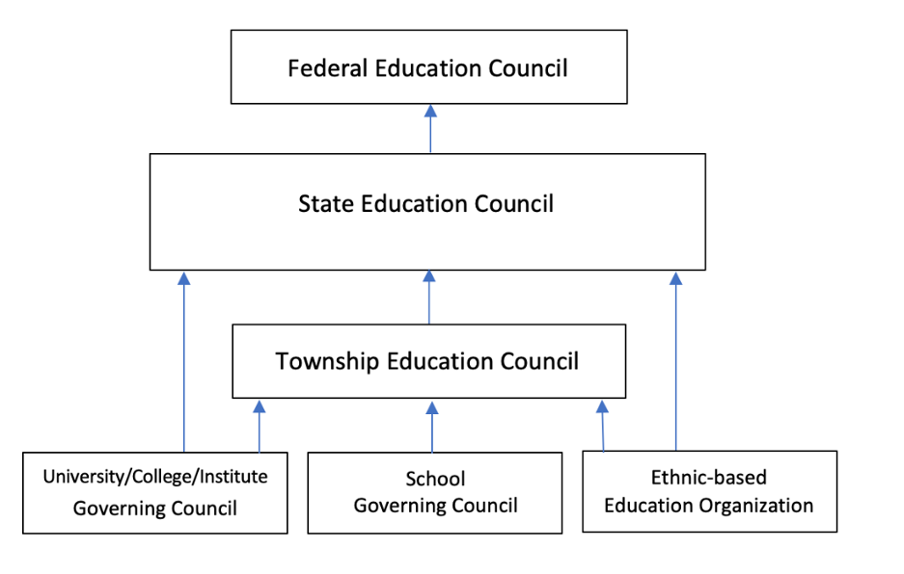
Figure 1: Administrative Structure in Federal Democracy Education Policy
Key Findings and Analysis
According to Michael Lipsky’s framework, an organization’s actual policy is not found in its high-level mandates but in the daily decisions, routines, and improvisations of the frontline workers who interact with the public. In the Sagaing context, teachers, school heads, and township education boards are the grassroots implementers, and their daily coping mechanisms shape policy outcomes.
Policy awareness gap
Amid active conflict, the education actors are trying to continue supporting student education in their areas. The analysis found that some school heads are “excited” about the FDEP’s promise of “academic” freedom, but the township-level and state-level policy advocacy remains limited. This lack of institutional support forced educators to defend the policy themselves. Furthermore, the state-level officer shared that they only distributed soft copies of the FDEP via digital networks, and the state-level training has not started yet. To fill these gaps, a few schools are self-initiating “Awareness workshops” and “Competency trainings”. However, the number of schools that implement the policy values is relatively low at present.
Financing and resource constraints
In prolonged conflicts before the 2021 coup, education expenditures were consistently lower than military expenditures. The findings reveal a systemic failure in central funding over the past year in Sagaing. Schools rely heavily on local community distributions and external donors, “overseas supporters,” for school-level funding, but these resources are limited. Beyond the lack of basic needs such as teaching aids and school buildings, limited teacher resources and these scarcities became barriers to implementing the policy. Coping mechanisms in the region include using waste materials or local items for experiments instead of labs and modern teaching aids. This is a clear example of Lipsky’s “discretion,” where teachers modify the curriculum based on available tools. Schools are built with temporary materials because permanent structures are liabilities. Educators avoid “high-profile” setups, such as permanent solar installations, so they can flee quickly if a “ground column” approaches.
Lipsky argues that resource scarcity leads to “Rationing Services.” In Sagaing, teachers are prioritizing survival education over standardization. The strategic coping mechanisms for financing and resource constraints remain a priority agenda to build the foundation of federal democracy education in practice.
Decentralization vs. residual centralization
As Michael Lipsky argued, “Street-level Bureaucrats have a certain amount of relative autonomy from their organizations; they are not just cogs in a machine but individuals who can ignore or adapt centralized instructions to fit the ground reality.” Analysis indicates that the decentralized administrative shift at the school level yielded positive results for policy practice and aligned with the FDEP’s structure. In the findings, support from some township-level and national-level educational authorities remains limited for implementing the FDEP during the revolution period for security reasons. In Sagaing, at least, teachers have classroom-level autonomy to reject the curriculum that no longer aligns with the revolutionary context or the community’s values. But the state needs urgent support to empower the organizational decentralization practices.
Security vs. Educational Continuity
The “Do No Harm” principle is the primary driver of education in Sagaing. Schools operate under the constant threat of “Daily Air Strikes,” often located just a few miles from the military frontline outpost. The proximity to violence led to a higher student dropout rate in some areas after 5 years of interim schools. Parents often move children to junta-controlled schools not out of political loyalty, but to seek “ official certification” and a perceived sense of “safety” from aerial targeting. To cope with these challenges, schools build bunkers and use “Warning systems” to alert the community. School locations and teachers’ and students’ profiles are kept low-profile on social media platforms.
Overall, the decentralized shift from the headmaster as a “sole authority” to a “lightbulb” in a collective circuit represents the most significant success of FDEP to date. Policy outcomes at the regional level remain uncertain under the lower level of coping mechanisms for challenges. The way grassroots educators shape implementation through their localized coping system affects the rate of policy outcomes.
Recommendations
Provide Policy Awareness Campaign
To empower grassroots implementers, prioritizing outreach to policy values, objectives, and the foundations of decentralization is the priority function. Based on the analysis, distributing soft copies and holding previous awareness sessions were insufficient to capture key concepts and implementation in the Sagaing setting. Not only frontline education implementers but also students, parents, and the local community require an understanding of educational transformation. Hence, the policy drafters, the Interim Federal Education Council, and state-level education officials need to reinitiate a nationwide effective policy awareness campaign to lay the groundwork for a future federal democratic education system.
| Steps | Recommended Process |
| Build Consensus and Joint Formations | Identify the leadership team, composed of representatives from SFUIG, NUG, and IFEC. Define campaign objectives and timelines, and maintain an open structure. Provide TORs, secure communication channels, and a rapid-response protocol given the conflict setting of the implementation area. Focus on collective leadership while setting clear roles and responsibilities among stakeholders. Identify additional partners such as local governance 3Ps, Local CSOs, NGOs, INGOs, people movement forces, media and influencers, political leaders, student unions, teacher unions, and LEBs. Provide sub-groups for public awareness and media, local coordination, finance, capacity, and training. |
| Localize and translate the content: | Translate the complex policy documents into localized toolkits. Avoid complex academic jargon by producing audio, video, and print assets in major regional languages to overcome barriers. |
| Conduct “Township-level” Forums | Roll out capacity-building workshops directly across the township. Train local education officers and teacher trainers on mandates and volunteer-based work. Hand over to grassroots teachers in each area in the townships |
| Launch Grassroots Mass Socialization: | Activate the regionwide public push using localized FM radio spots, street notice boards in remote districts, and localized social media content. Direct campaigns toward empowering rural parents and the community to participate in the transition to a decentralized and competency-based education system. |
The political feasibility is high due to the willingness of state-level education officials to commit to the policy. The success of the implementation might depend on security, availability of human resources, and the presence of massive campaigns.
Support the Formation of Education Councils
Encouraging the Education Council’s startup by adopting a localized structure for policy administration could be an investment in future changes.
Provide Education Council guidelines or framework: Organize the guideline or framework drafting committee at the state level, consisting of representatives from primary policy drafters, the Interim Federal Education Council, the state-level education ministry, township-level education board, school heads, student unions, teacher unions, and the education consultants.
For example, sampling the following school governing council administrative structures implemented successfully in Kalay township, Sagaing.
| Stakeholder Group | Composition | Strategic Role in Governance |
| Admin Role | School administration department head, School Head, and Methodology Department Head. | Oversight of daily operations and administrative implementation; acting as a functional unit of the council. |
| Teachers Union | Elected representatives from Primary, Middle, and High school levels. | Leading academic development and preventing the return to absolute authority (the “single lightbulb” model) |
| Students Union | Representatives nominated by the Student President at the Primary, Middle, and High school levels.
|
Serving as independent voices for the student body, no longer “handheld” tools of the administration. |
| Community Leaders | Regional representatives from the local Pa-Eh-Pha or the local administrative group. | Ensuring that the school aligns with regional administrative goals and community needs. |
| Parents | Elected representatives from Primary, Middle, and High school levels. | Providing parental oversight and fostering community-wide trust in the federal model. |
Create a safe channel: Consult on the needs of forming education councils for schools and townships, and deliver support through this channel for both online and on-ground schools hosted by the guideline drafting committee.
The fostering and guidance to build the foundational structure of education are recommended to be funded by state expenditure and community support. The feasibility of the option depends on the stakeholders’ security, resource availability, and willingness to support the transition.
Secure the financial and resource limitations of the frontliners
Addressing the scarcity of grassroots implementers in every possible way directly affects the effectiveness of policy implementation, drawing on Lipsky’s concept. Conducting crowdfunding helps the revolutionary government and local community by reducing the funding burden.
Consultation to organize the crowdfunding committee: The Sagaing State-level Education officials should initiate consultations with the finance department, the schools’ governing councils, NGOs, INGOs, media, corporate partners, and international diaspora communities to build the crowdfunding committee to support education. The committee members must be elected with bottom-up elected representatives from each township administrative council.
Establish Security and Transparency Framework: The committee must adhere to strict digital security guidelines and a “Do No Harm” Terms of Reference ( TOR) to build public trust.
Monitoring and Evaluation: The education ministry of the Sagaing federal unit monitors the committee’s reports and implementation within the scope of the Federal Democracy Education policy (FDEP).
Follow FDEP for Permanent Federal Union: At least the country’s GDP 4-6% or 15-20% of total Union public expenditure must be allocated for Education in the Federal Constitution, due to recommendations of UNESCO.
Conclusion
The frontliners of basic education in Sagaing have heroically initiated the Federal education amidst junta repression, yet deep-rooted centralization, resource gaps, and policy gaps stall progress. Moving from “survival schooling” to sustainable FDE Policy implementation requires aggressive policy advocacy, protected decentralized autonomy, and robust crowdfunding. Cultivating participatory decision-making in classrooms and at the grassroots level, following the FDEP, can be the foundation of building a future federal democratic country.
References
[1] Lipsky, M. (2010). Street-level bureaucracy: Dilemmas of the individual in public services (Thirtieth anniversary, expanded ed.). Russell Sage Foundation.
[2] Zaw, N. Y., Maung, Y. Y., Tun, H. M., Soe, T. Z., Lin, Z. Y., & Latt, Z. M. (2024). Revolutionizing basic education: Challenges of federal education in Myanmar. Brazilian Journal of Development, 10(11), 1–30
[3] Majone, G., & Wildavsky, A. (1984). Implementation as evolution (1979). In J. L. Pressman & A. Wildavsky, Implementation: How great expectations in Washington are dashed in Oakland; or, why it’s amazing that federal programs work at all (3rd ed., pp. 163–180). University of California Press.
[4] Institute for Peace and Social Justice (IPSJ). (2025, December 3). Groundbreaking research reveals: Bottom-up education boards as the engine for Myanmar’s federal transition.
https://www.ipsj.org/groundbreaking-research-reveals-bottom-up-education-boards-as-the-engine-for-myanmars-federal-transition/
[5] Sadhana Chaudhary. (2026). Challenges and opportunities of decentralized educational planning in Nepal. Chhahari: A Multidisciplinary Peer-review Research Journal, 3 (1)
[6] Thein Lwin. (2021). Challenges and opportunities for education reform: Under the new Myanmar government.
[7] National Unity Consultative Council. (2023, May 8). Federal Democracy Education Policy.
[8] Sagaing Federal Unit Interim Constitution. (2025, June 25). Chapter (13). Education, Health, and Social Security.https://www.facebook.com/sagaingfuh/posts/english-version-of-the-interim-constitution-of-the-sagaing-federal-unitto-obtain/1151846027084914/
[9] Than Lwin Times. (2024, August 15). NUG has established nearly 6,000 schools. Burma News International.https://www.bnionline.net/en/news/nug-has-established-nearly-6000-schools
[10] Burma News International. (2023, June 1). “We are developing the ability to make changes and build the future”: An interview with NUG Deputy Education Minister Dr. Sai Khaing Myo Tun. Burma Library.
[11] The Irrawaddy. (2023, June 26). School life in the crosshairs of Myanmar junta’s warplanes and gunships.https://www.irrawaddy.com/news/burma/school-life-in-the-crosshairs-of-myanmar-juntas-warplanes-and-gunships.html
Download full article: Click