
From Family Responsibility to Social Solidarity Protecting Older People from Extreme Heat in Thailand

Sirathan Kittithananithikul1, Lakchayaporn Thansiri2, and Kampanat Klaisubun3,
School of Public Policy, Chiang Mai University, Thailand.
¹ sirathan.kit@gmail.com; ² lakchayaporn.thansiri@gmail.com; ³ Kampanat@nesdc.go.th
1. The problem
Thailand faces two connected changes: rapid population ageing and increasing exposure to extreme heat. In 2024, Thailand had 14.03 million people aged 60 or above; 12.9 per cent lived alone, compared with 3.6 per cent in 1994, and only 7.1 per cent lived in homes meeting the national survey’s criteria for an appropriate older-person environment. Heat risk therefore reflects not only temperature and age, but also health, mobility, social support, housing and the affordability of cooling (National Statistical Office, 2024).
The risk is expected to grow. Under a high-emissions scenario, the World Health Organization (WHO) projects that heat-related mortality among people aged 65 and older could increase from a historical baseline of about 3 to approximately 58 deaths per 100,000 by 2080 (World Health Organization, 2015). Thailand’s National Adaptation Plan identifies older people as a health-risk group and calls for surveillance, proactive public-health capacity, intersectoral cooperation and public participation (Department of Climate Change and Environment, 2024). It does not, however, translate these commitments into an integrated cross-agency system capable of recognising and responding to the health, social, housing and environmental dimensions of older people’s heat risk.
Responsibility for protecting older people from extreme heat remains fragmented across multiple public institutions. These include the Department of Climate Change and Environment (DCCE), the Thai Meteorological Department (TMD), the Department of Health (DOH), the National Health Security Office (NHSO), the Department of Older Persons (DOP), local administrative organisations (LAOs) and the Energy Regulatory Commission (ERC). Each manages part of the problem through separate mandates, information systems, eligibility rules and budgets. No coordinating structure currently combines their assessments, assigns cross-agency duties or links rising risk to timely care, cooling, transport and home support. As families become smaller and more older people live alone, family availability cannot remain an implicit condition of protection. The proposed approach does not replace family or community care; it establishes public responsibilities and resources so that a population-level climate risk is not carried primarily by households. It also recognises older people as contributors: 34.0 per cent were still working in 2024, while many others contribute through family and community roles (National Statistical Office, 2024).
Against this backdrop, the policy question that emerges is this: How can Thailand use existing climate, health, ageing and local-government institutions to identify older people at risk and act before extreme heat becomes a medical emergency?
2. Policy Analysis
Extreme heat raises institutional questions about recognition, responsibility and access. This analysis combines institutional analysis with three principles for solidaristic institutions: respect for equal dignity and people’s capacity to contribute, indirect reciprocity, and non-humiliation (Prainsack, 2026). Institutional analysis locates divisions in authority, information and resources. The principles assess their effects on people. In this brief, a solidaristic institution recognises people’s capacities, pools contributions across society and provides support without requiring demonstrations of helplessness or deservingness.
2.1 Fragmented governance: institutional invisibility undermines respect for everybody’s equal dignity and their capacity to contribute
Government agencies address separate dimensions of heat risk. The Thai Meteorological Department provides weather observations and forecasts; the Department of Health issues a four-level Heat Index and health advice; health services hold clinical and functional information; older-person and local-government systems assess household and social conditions; and the Department of Older Persons supports selected home modifications. These functions operate through separate mandates and were not designed to produce a shared assessment of climate-related household risk (Department of Climate Change and Environment, 2024; Department of Older Persons, 2026; Department of Health, 2026; National Health Security Office, 2024).
Viewed through the first Design Principle for policies and institutions of solidarity, respect for everyone’s equal dignity and their capacity to contribute (Prainsack 2026), this institutional separation has two effects. First, clinical, meteorological, social and housing information does not jointly determine eligibility for a coordinated response. Second, older people are seen mainly through the lens of vulnerability, rather than their specific life circumstances and capacities. A fuller approach would include their participation in setting assessment criteria and voluntary roles as local advisers or warning leaders.
2.2 Warning without reach: conditional protection embeds humiliation
Thailand has existing policy instruments to address extreme heat and climate-related risks. The Heat Index communicates four levels of health risk, while the National Adaptation Plan calls for surveillance, proactive public-health capacity, improved insurance criteria for climate-related risks and intersectoral cooperation. These measures remain broad and do not constitute a common operational protocol for older people at compounded risk (Department of Climate Change and Environment, 2024; Department of Health, 2026).
Heat warnings primarily provide information and do not consistently assign responsibility for contacting high-risk households, conducting home visits, opening cooling spaces or arranging transport. Implementation consequently varies with local capacity and discretion.
Non-humiliation is the third Design Principle of solidarity. In this context, the principle draws attention to both material access and eligibility. Heat advisories cannot by themselves address differences in households’ capacity to respond to heat-related risks. Effective protection also depends on potable water, affordable electricity, thermally safe housing, transport and nearby assistance. Existing eligibility rules are generally linked to illness, functional dependency or programme-specific assessments rather than prospective heat exposure. Protection therefore varies across income groups, housing conditions and local service environments, and preventive support may remain inaccessible until dependency or illness is established.
2.3 Public risk, privatised responsibility: The limits of collective provision
This gap is examined through the second Design Principle of solidarity, indirect reciprocity. Existing arrangements distribute the costs of heat protection across older people, families, community volunteers and local authorities. Households finance electricity and home improvements, families absorb care costs, and Village Health Volunteers (VHV) and local services undertake seasonal work without a dedicated allocation. Prevention remains weakly covered by existing programme criteria.
Although extreme heat is a population-level risk, access to cooling and home adaptation remains substantially dependent on private household resources. Indirect reciprocity supports collective provision in which contributions are pooled according to capacity and support is distributed through existing institutions according to assessed risk and need. This provides the basis for immediate budget additions and, once authorised by legislation, earmarked climate-finance revenue.
2.4 From structural gaps to solidaristic institutional design
The three gaps are connected: fragmented institutions cannot recognise compounded risk; warnings without assigned duties leave protection dependent on private resources; and preventive duties cannot be sustained without funding. A solidarity-based response must combine shared risk recognition, action before collapse and materially accessible protection through existing institutions.
3. Policy recommendations
To address these structural gaps, we propose a coordinated policy framework that connects risk identification, preventive action, and material support. A temporary cross-agency structure would establish the shared framework and assign responsibilities, while existing institutions and financial channels would deliver the response.
Figure 1 presents the framework as a whole:
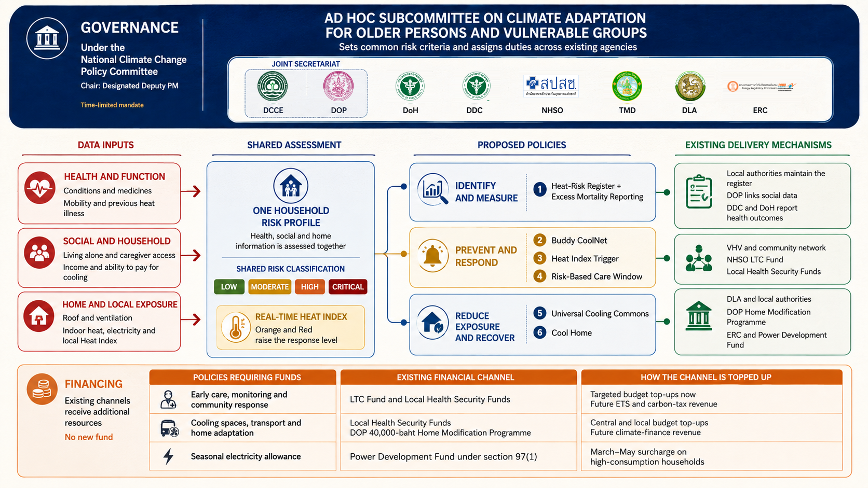
Figure 1. Proposed institutional framework for protecting older people from extreme heat
3.1 A temporary structure for cross-agency coordination
The Cabinet should establish an Ad Hoc Subcommittee on Climate Adaptation for Older Persons and Vulnerable Groups under the National Climate Change Policy Committee. Its time-limited mandate should be to agree the shared risk framework, assign responsibilities, coordinate implementation and embed those duties in existing agencies.
The Department of Climate Change and Environment and the Department of Older Persons should serve as joint secretariat. Core members should include the Department of Health, Department of Disease Control, National Health Security Office, Thai Meteorological Department, Department of Local Administration and Energy Regulatory Commission. BDI, NSO and DDPM may advise when relevant, while older people and community representatives should participate in setting criteria and reviewing access. Once the protocol is agreed, Heat Index levels should activate agency duties without further subcommittee approval.
3.2 A shared risk framework
Participating agencies should combine existing health and functional, social and household, housing and local heat information into one household risk profile, classified as low, moderate, high or critical. Local authorities should maintain the register with community input, while health agencies report outcomes and excess mortality. Data sharing should have a defined purpose, use only necessary fields, restrict access by role and allow households to correct their records. Assessed risk should determine preventive eligibility without requiring proof that heat directly caused a qualifying illness.
3.3 Six measures to be delivered through existing institutions
- Heat-risk register and excess-mortality reporting. Local authorities would combine health, functional, household, housing and local heat information into a shared risk profile. Health agencies would separately report hot-season outcomes and excess mortality by age and area, making harm visible beyond diagnoses that explicitly name heat.
- Buddy CoolNet. Village Health Volunteers, neighbours and local residents would share scheduled check-ins with registered high-risk households during Orange and Red periods. Participation should be voluntary, with training, equipment, supervision and funded staff time so that prevention does not become an unpaid local burden.
- Heat Index trigger. The existing four-level Heat Index would become an operational trigger rather than information alone. Each level would activate duties agreed in advance, linking national warnings to household contact, cooling spaces, transport and in-person response.
- Risk-based care window. NHSO and local health channels would extend monitoring and follow-up to people whose combined risk is high before they meet dependency-based criteria. Eligibility would follow assessed need, without requiring illness or proof that heat directly caused it.
- Universal Cooling Commons. Local authorities would designate accessible public facilities as cooling spaces, publish opening arrangements and connect them with transport and community outreach. Universal access would avoid requiring older people to present themselves as welfare recipients.
- Cool home. The existing home-modification route would add thermal-safety criteria, including shading, ventilation and heat-reducing improvements. Seasonal electricity support would help eligible households use essential cooling without displacing other basic expenditure.
3.4 Duties activated by the heat index
The Department of Health’s four-level Heat Index should remain the operational trigger. Yellow should prompt public information; Orange should require contact with registered high-risk households; and Red should activate an in-person response where risk warrants it, with cooling spaces open and transport available. Agencies should agree detailed protocols and escalation routes before implementation, then report coverage, response time, service use and health outcomes after each hot season.
3.5 Financing through existing channels
Existing funds and programmes should remain the financial and delivery channels. This does not imply that money is already available: responsible authorities should revise eligibility and scope and, where necessary, activate new contribution rates. Immediate budget additions and future statutory revenue should finance staff time, equipment, supervision and the additional duties.
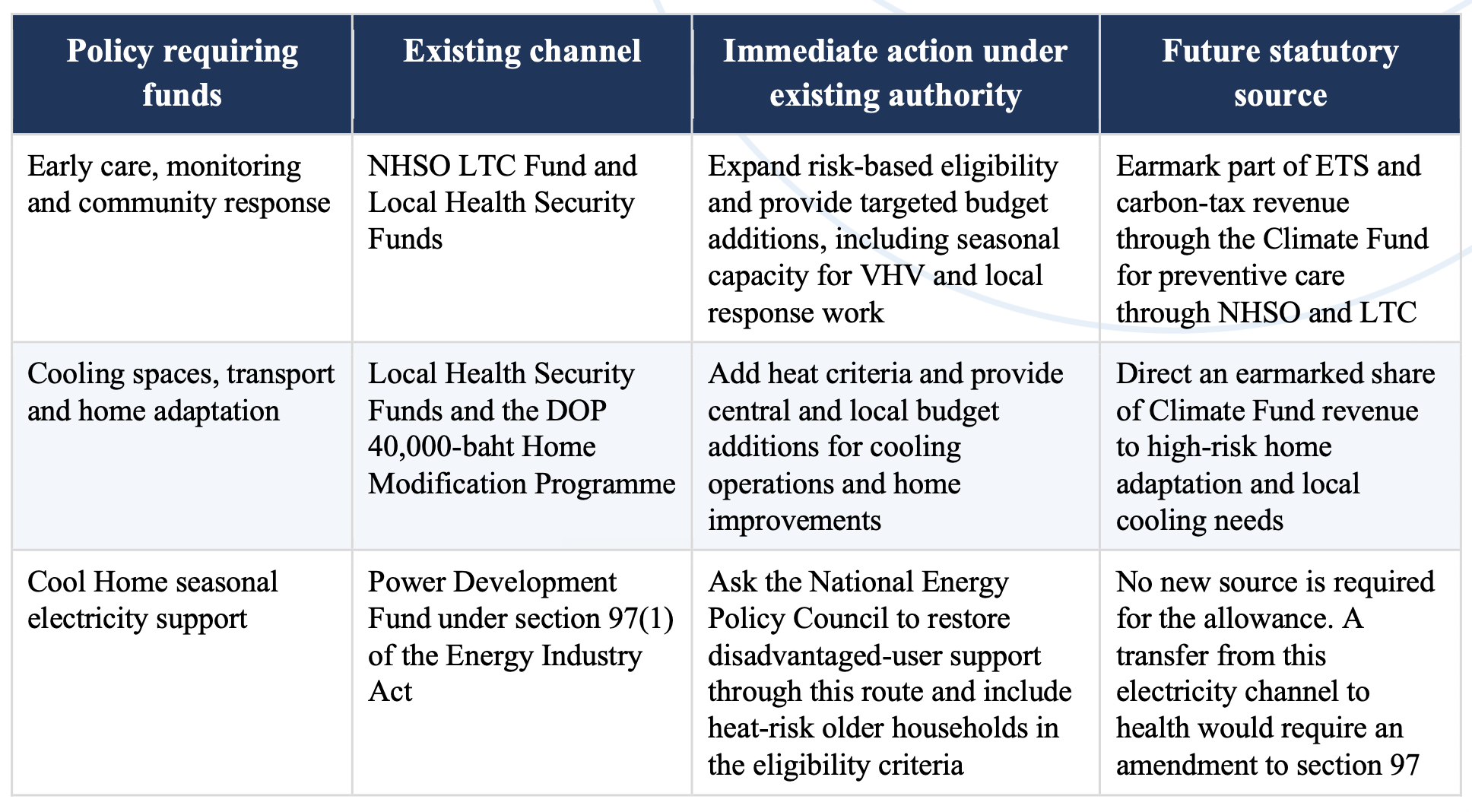
The draft Climate Change Act provides for a Climate Fund, emissions trading and carbon taxation. An earmarked share should support adaptation for older people and other high-risk groups through existing LTC and home-modification channels. Until enactment, implementation should rely on targeted budget additions and current regulatory authority.
4. Conclusion
Thailand can strengthen protection from extreme heat by coordinating existing institutions around a shared risk framework, pre-agreed duties and funded preventive support. The six measures provide an operating model that begins before collapse, preserves non-humiliating access and recognises older people’s capacity to contribute. Existing channels permit immediate implementation, while future climate-finance revenue can support continuity.
5. References
- Department of Climate Change and Environment. (2024). Thailand’s National Adaptation Plan. Ministry of Natural Resources and Environment. https://www.dcce.go.th/datacenter/6587/
- Department of Health. (2026). Heat Index surveillance and systematic response to heat-related health risks. Ministry of Public Health. https://anamai.moph.go.th/th/news-anamai/44911
- Department of Climate Change and Environment. (2025). Draft Climate Change Act B.E. …. https://www.dcce.go.th/media/14863/
- Department of Older Persons. (2026). Manual for the Environmental Adjustment and Safety Facilities Project for Older Persons for Fiscal Year 2026. Ministry of Social Development and Human Security.
- Energy Regulatory Commission. (n.d.). Power Development Fund under section 97(1): Subsidies for disadvantaged electricity users. https://pdfweb.erc.or.th/eFundPortalV2/
- National Health Security Office. (2024). Management of the Local Health Security Fund. https://media.nhso.go.th/assets/portals/1/files/E-Book_TH/67-2_Local%20Fund%20TH%20Book.pdf
- National Statistical Office. (2021). The 2021 Survey of Older Persons in Thailand. Ministry of Digital Economy and Society. https://catalogapi.nso.go.th/api/doc/department/D12/D12_P01/D12_P01_43_2.pdf
- National Statistical Office. (2024). The 2024 Survey of Older Persons in Thailand. Ministry of Digital Economy and Society. https://www.nso.go.th/nsoweb/nso/survey_detail/iM?set_lang=en
- Prainsack, B., & Buyx, A. (2018). The value of work: Addressing the future of work through the lens of solidarity. Bioethics, 32(9), 585-592. https://doi.org/10.1111/bioe.12507
- Prainsack, B. (2026). States of solidarity: How to build a society. Oxford University Press. https://doi.org/10.1093/9780198965336.001.0001
- Department of Older Persons, College of Population Studies, Chulalongkorn University, & Co-host Partners. (2025). Recommendations and proposed actionable measures: Strengthening inclusive and equitable care systems in the context of an ageing society. Department of Older Persons and College of Population Studies, Chulalongkorn University. https://www.dop.go.th/download/news/th1768979626-6076_0.pdf
- World Health Organization. (2015). Climate and Health Country Profile: Thailand. https://cdn.who.int/media/docs/default-source/searo/wsh-och-searo/tha-c-h-profile.pdf
6. Generative AI Statement
The authors declare that generative AI was used in the preparation of this manuscript. Claude Sonnet 4.6 (Anthropic) was used to assist with the systematic retrieval of potentially relevant passages from Thai-language policy documents. ChatGPT, GPT-5.6 Sol (OpenAI), was used to support language editing, structural refinement, and clarity during manuscript revision, as well as to generate a visual representation of the proposed working framework presented in Figure 1. Google Gemini (Google) was used to assist with summarising source materials and checking grammar. All AI-assisted outputs were reviewed and validated by the authors, who take full responsibility for the content of the manuscript.
Download full article: Click