
BEYOND SAFE HOUSING: REVISITING VIETNAM'S PLANNED RELOCATION POLICY THROUGH COMMUNITY PERSPECTIVES
On 19 September 2026 by SPP
Author: Nguyen Thi Hoang Nguyen
Advisor: Thida Chaiyapa
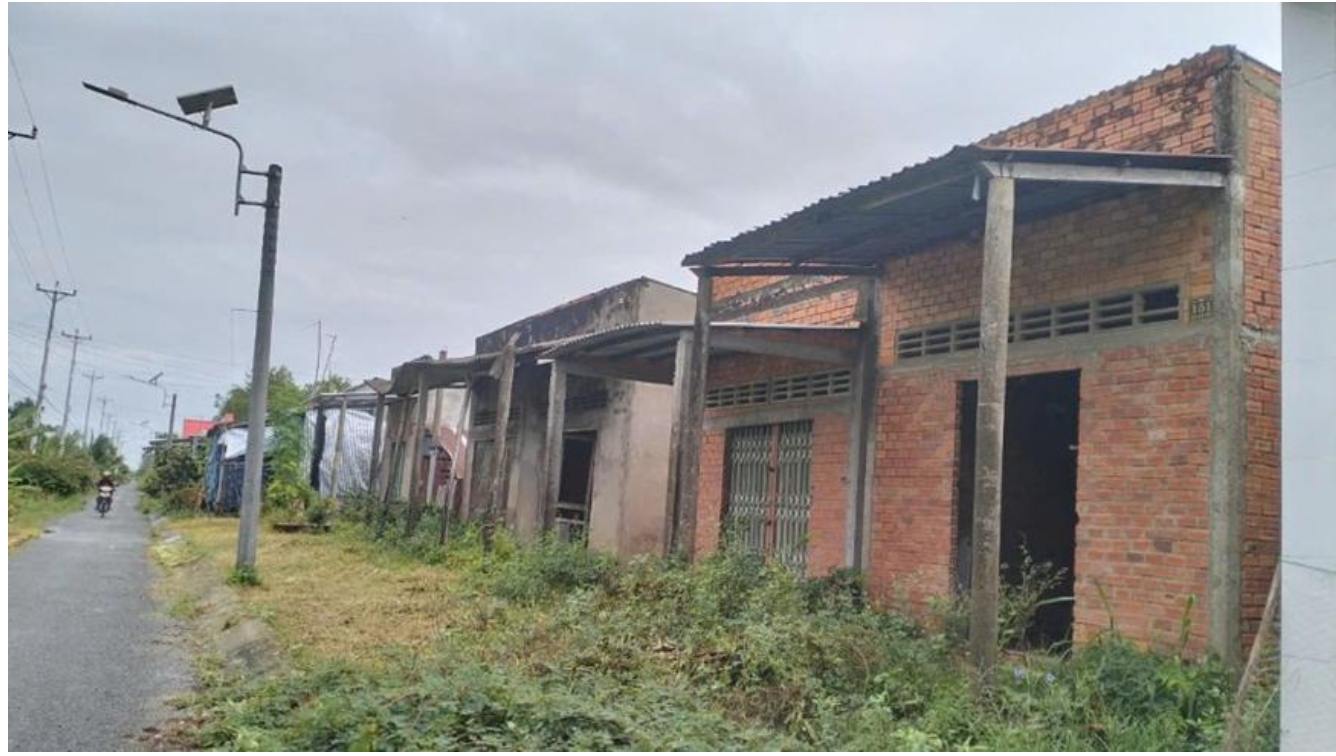
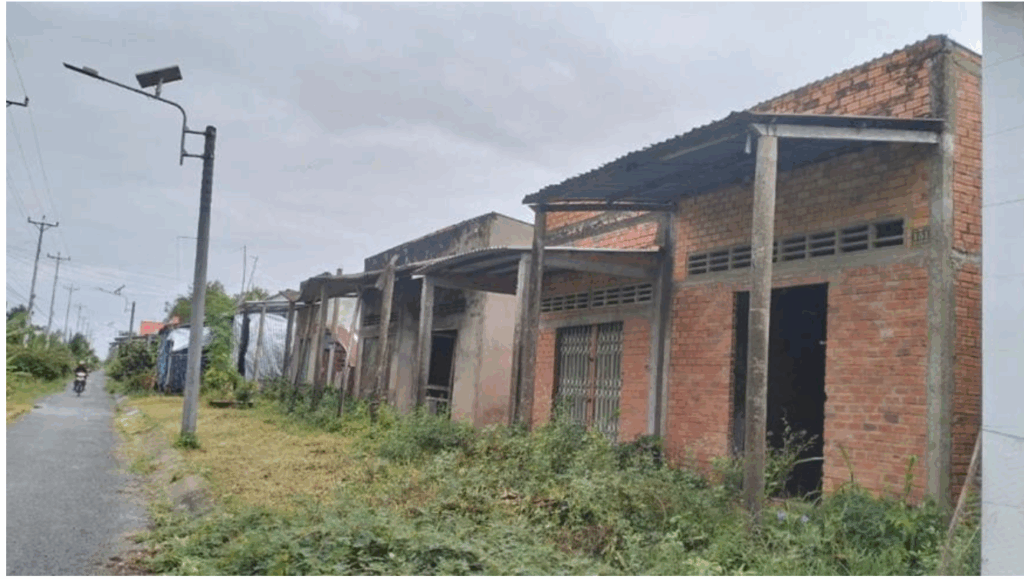
A row of abandoned houses at Ca No resettlement cluster in Long An Province. (Huynh, 2023)
EXECUTIVE SUMMARY
Across Vietnam’s Mekong Delta, government-built resettlement clusters have become one of the country’s most visible responses to floods, riverbank erosion, and other environmental hazards. Since the implementation of the Living with Floods program in the early 2000s, thousands of households have been relocated from high-risk areas to safer residential sites equipped with roads, electricity, schools, and healthcare facilities [1-3]. Over time, this model has been replicated across the Delta and incorporated into Vietnam’s broader climate adaptation strategy [4, 5].
The program has generally been regarded as a success. Government agencies and international organizations have highlighted improvements in physical safety, housing quality, and access to infrastructure [6, 7]. These achievements demonstrate the important role that planned relocation can play in reducing disaster risks and protecting vulnerable communities.
However, reports of abandoned houses and continued migration from some resettlement sites [8, 9] suggest that safer housing alone may not guarantee long-term resilience. These observations raise an important policy question: Does planned relocation continue to meet the needs of relocated communities more than two decades after many programs were first implemented?
This policy brief argues that the answer requires moving beyond traditional measures of policy success. Existing evaluations have largely assessed relocation through technical indicators such as the number of houses constructed, infrastructure delivered, or reductions in exposure to floods and erosion. While these indicators remain important, they provide only a partial understanding of policy effectiveness. Successful adaptation also depends on whether relocated households are able to rebuild secure livelihoods, maintain financial stability, and create sustainable futures for their families.
Drawing on Frank Fischer’s [10] concept of Situational Validation, this brief examines whether Vietnam’s planned relocation policy continues to fit the social and economic realities of the communities it was designed to protect. The analysis combines documentary evidence with semi-structured interviews conducted with five relocated households in three resettlement clusters in Can Tho City.
ABOUT THE STUDY
This policy brief summarizes findings an Independent Study examining whether Vietnam’s planned relocation policy continues to meet the needs of relocated communities more than two decades after its introduction. The study applies Frank Fischer’s [10] concept of Situational Validation, which evaluates whether a policy remains appropriate to the social and economic realities of the people it is intended to serve, rather than assessing only whether it achieved its original objectives.
The analysis combines a review of government policies, international reports, and previous research with primary data collected from five relocated households living in three government resettlement sites in Can Tho City (An Binh, Phong Dien, and Ninh Kieu). Before each semi-structured interview, participants completed a short questionnaire to provide background information and identify the issues they considered most important after relocation. Although relocation plans had been announced approximately ten years earlier, most participants had moved into the resettlement sites only within the previous two or three years, providing recent perspectives on the implementation of Vietnam’s planned relocation policy.
FINDINGS FROM COMMUNITY PERSPECTIVES
Safer Housing Is Only One Dimension of Successful Adaptation
The findings confirm that planned relocation has achieved many of its original objectives. Interview participants consistently recognized that relocation had improved physical safety and living conditions. Safer housing, better roads, electricity, and easier access to schools and healthcare represented meaningful improvements compared with their previous living environments. These findings are consistent with previous government and international assessments of Vietnam’s relocation programs.
Nevertheless, participants viewed successful adaptation more broadly than physical safety alone. Across both the literature and interviews, livelihood security emerged as the most important concern after relocation. Several participants described how moving disrupted their existing sources of income. Those who had previously depended on agriculture or roadside businesses found it difficult to recreate these livelihoods within the new resettlement sites. One participant who formerly relied on fruit cultivation explained that relocation left his family without access to agricultural land, forcing him to earn a living through informal street vending. Another participant reported losing customers because the new house was located away from the main road.
Financial insecurity further complicated these challenges. Although households received various forms of government support, including compensation, residential plots, relocation allowances, or concessional loans depending on the program, many remained responsible for financing house construction themselves. Rising construction costs and delays between compensation and relocation reduced the value of this support, leaving some households to borrow money. Participants described long-term debt as a continuing burden that limited their ability to rebuild stable lives after relocation.
Community participation also remained limited. While interviewees generally accepted relocation and recognized the benefits of moving to safer locations, most reported having little influence over important decisions such as relocation sites, housing design, or livelihood planning. Consultation primarily focused on compensation procedures rather than allowing residents to shape the broader relocation process.
These findings suggest that relocation has successfully reduced environmental vulnerability but has not always translated into long-term social and economic resilience.
Community Needs Have Changed
One of the most significant findings of the study is that community priorities have evolved since the first relocation programs were introduced more than twenty years ago.
The Living with Floods [1] program was introduced following the devastating 1996 floods in the Mekong Delta. Its primary objective was to relocate households living in flood-prone and erosion-prone areas into government-supported residential clusters equipped with safer housing and basic infrastructure such as roads, electricity, schools, and healthcare facilities. Over time, this model was expanded across the Mekong Delta and incorporated into Vietnam’s broader climate adaptation strategy, becoming one of the country’s most prominent planned relocation programs.
Among the five relocated households interviewed across three government resettlement sites in Can Tho City, two participants described neighbors selling their houses or moving elsewhere in search of employment. These observations do not suggest that relocation has failed; rather, they indicate that household priorities and livelihood needs have evolved since the programs were first designed.
This insight reflects Frank Fischer’s concept of Situational Validation, which argues that public policies should not only achieve their original objectives but should also remain appropriate to the communities they are intended to serve. A policy that effectively addressed environmental risks two decades ago may require adaptation if community circumstances, aspirations, and livelihoods have changed.
From this perspective, the central policy question is no longer whether planned relocation reduces exposure to floods. Instead, it is whether relocation policies continue to support the broader conditions that communities themselves associate with living secure, resilient, and prosperous lives.
RECOMMENDATIONS AND CONCLUSION
Vietnam’s planned relocation policy remains an important component of climate adaptation in the Mekong Delta. The program has successfully reduced exposure to environmental hazards and improved housing conditions for many households. These achievements should not be overlooked.
However, findings from this research demonstrate that technical achievements alone provide only a partial understanding of policy effectiveness. Community experiences reveal that long-term resilience also depends on livelihood restoration, financial stability, meaningful participation, and continued responsiveness to changing community priorities. Incorporating these perspectives into policy evaluation would enable relocation programs to evolve alongside the communities they are intended to protect.
Recommendation 1: Conduct Regular Community Needs Assessments
Community priorities do not remain static. Government agencies should therefore conduct periodic assessments before, during, and after relocation to understand how household needs change over time. These assessments should complement existing technical indicators by examining employment, income security, access to services, community well-being, and residents’ own perceptions of successful adaptation. Regular evaluation would allow relocation programs to respond more effectively to changing social and economic conditions.
Recommendation 2: Strengthen Livelihood Restoration After Relocation
Relocation policies should place greater emphasis on rebuilding sustainable livelihoods alongside providing safer housing. Support measures could include vocational training, employment placement services, access to affordable credit, livelihood grants, and assistance for small businesses that reflect local economic opportunities. Continued economic support after relocation would reduce financial vulnerability and improve households’ capacity to achieve long-term resilience.
Recommendation 3: Integrate Community Perspectives Throughout the Relocation Process
Community participation should extend beyond compensation arrangements to become a core element of relocation planning, implementation, and evaluation. Residents should have greater opportunities to contribute to decisions regarding relocation sites, housing design, livelihood planning, and post-relocation support. Embedding community perspectives throughout the policy cycle would provide a more comprehensive understanding of policy effectiveness while ensuring that relocation programs remain responsive to evolving local realities.
Recommendation 4: Preserve Social Networks and Community Well-being
Relocation planning should pay greater attention to preserving social networks and community cohesion. Participants described changes in community relationships, and the loss of familiar support systems after relocation. Where possible, households from the same communities should be relocated together, and post-relocation programs should support community activities, local organizations, and opportunities for residents to rebuild social connections. Strengthening social capital alongside physical safety can improve long-term resilience and community well-being.
Conclusion
Planned relocation remains one of Vietnam’s most important climate adaptation strategies and has successfully reduced exposure to environmental hazards for thousands of households. However, this study demonstrates that long-term policy success cannot be measured by safer housing alone. As communities’ needs evolve, relocation policies must also evolve by placing greater emphasis on livelihoods, financial security, social well-being, and meaningful community participation. Incorporating these perspectives into future policy design and evaluation will help ensure that planned relocation continues to build resilient communities rather than simply relocating vulnerable households.
References
- Vo, T.D. and M. Shahbaz, Living with Floods: An Evaluation of the Resettlement Program of the Mekong Delta of Vietnam, in Environmental change and agricultural sustainability in the Mekong Delta, S. Mart A and C. Peter A, Editors. 2011, Springer Netherlands. p. 181–204.
- Chun, J.M., Planned relocations in the Mekong Delta, Vietnam: A successful model for climate change adaptation, a cautionary tale, or both? 2015, Brookings Institution.
- UNDP, Migration, Resettlement and Climate Change in Viet Nam – Reducing exposure and vulnerabilities to climatic extremes and stresses through spontaneous and guided migration. 2014, United Nations in Vietnam.
- Government, National Target Program to Respond to Climate Change in 2012–2015. 2012.
- Government, Resolution 120/NQ-CP on Sustainable and climate-resilient development of the Mekong Delta. 2017: Hanoi.
- IOM, Planned relocation for communities in the context of environmental change and climate Change: A training manual for provincial and local authorities. 2018, International Organization for Migration. p. 96.
- Lindegaard, L.S., Lessons from climate-related planned relocations: the case of Vietnam. Climate and Development, 2020. 12(7): p. 600–609.
- Huynh, D., Hundreds of flood-resistant houses have been abandoned for 20 years., in Law Newspaper. 2023.
- QĐND, A look back on flood-induced relocation: Part 1: Settled down does not guarantee a stable livelihood, in People’s Army. 2024: Vietnam.
- Fischer, F., Evaluating public policy. (No Title), 1995.