
Enhancing Thai Social Security System to be Modern, Transparent and Responsive to the modern workforce for Long-Term Stability

Author: Sasipapha Mimacha
Advisor: Piyapong Boossabong & William Patrick Kittredge
Background
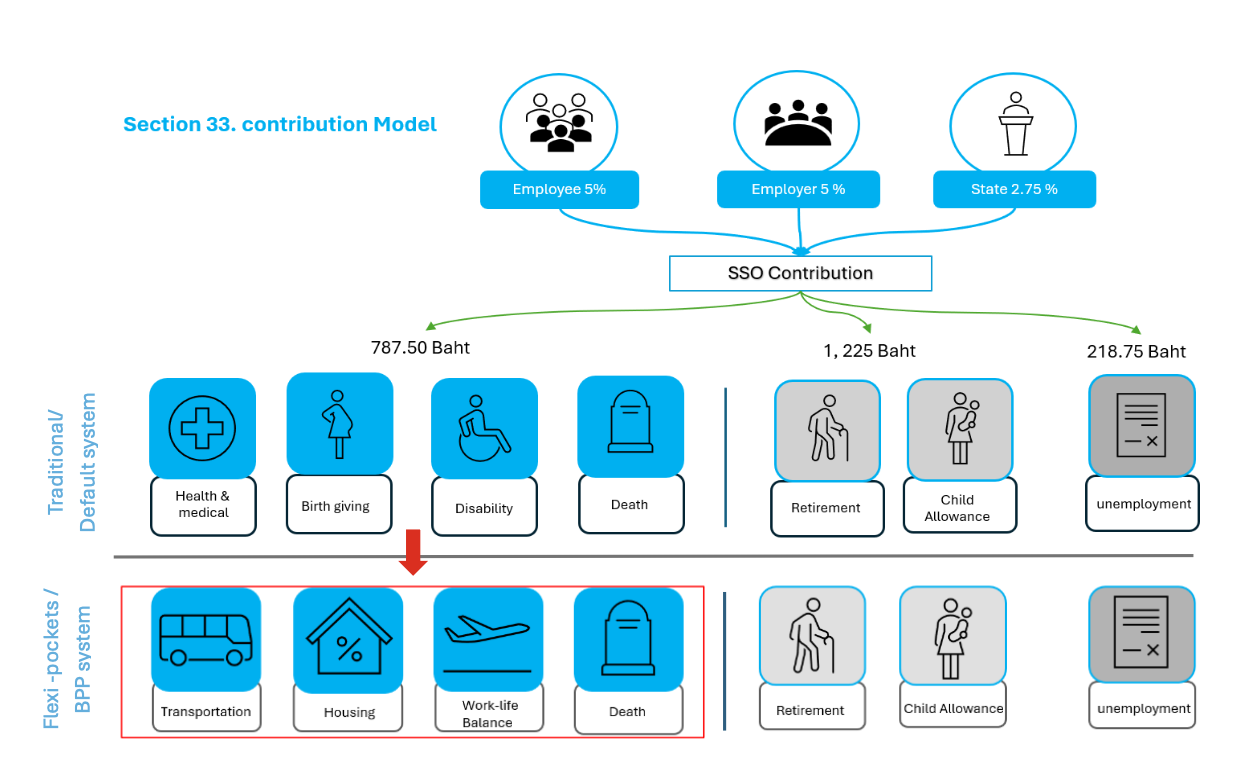
The Thai Social Security pension system, managed by the SSO, faces severe structural and fiscal challenges. Operating on a hybrid partial-funding and Pay-As-You-Go (PAYG) model, current contributions from the active workforce fund the pensions of the retired population (Poonpolkul et al., 2024). For Section 33 workers—formal private-sector employees who represent the financial base of the fund—this structure is maintained through a tripartite contribution framework matched by employees, employers, and the state.
However, this tripartite architecture is facing an existential crisis due to three compounding factors:
- The Demographic Collapse: Thailand’s rapid transition into a super-aging society is projected to collapse the active contributor-to-retiree ratio from an unsustainable 16:1 down to an alarming 3:1 within the next two decades (Mahosot, 2025).
- Benefit Over-Layering and Zero Marginal Utility: Many of the short-term benefits underutilized by healthy younger workers—specifically healthcare and invalidity provisions—directly replicate the coverage provided by Thailand’s tax-financed Universal Health Coverage (UHC) scheme (Chankhanti, 2020). For workers with alternative private employer coverage, these mandatory deductions yield Zero Marginal Utility, causing them to view social security as an invisible, regressive tax.
This misalignment results in a critical policy dilemma known as the Time-Inconsistency Problem (Kydland & Prescott, 1977). If the state fails to secure the retirement path of Section 33 workers today, it will be politically and ethically forced to bail them out using general tax revenues when they reach retirement age without adequate savings, triggering an avoidable fiscal crisis.
The Behavioural Bottleneck: Present Bias and Public Distrust
To restore institutional solvency, policy interventions must move from macroeconomic adjustments and address why the younger generation actively detaches from the system. Behavioral economics exposes two primary psychological barriers that paralyze modern worker participation:
- Present Bias and Hyperbolic Discounting: Modern Thai workers (under the age of 40) face severe household debt and economic constraints (Bank of Thailand, 2024). Driven by hyperbolic discounting, future retirement payouts decades away are discounted to near-zero utility. When faced with immediate living expenses, the worker’s cognitive focus is captured by short-term survival (Kahneman & Tversky, 1979; Thaler, 1981). Younger workers view long-term contributions as an immediate financial loss, leading to a breakdown in participation continuity during employment transitions.
- Deficit in Choice Architecture: The current SSO framework operates as a rigid, non-transparent single pool where workers possess zero agency over their capital allocation (Poonpolkul et al., 2024). This lack of choice, combined with administrative duplication, breeds a deep public trust deficit, cementing the perception of social security as an inescapable payroll tax rather than a valuable personal asset.
A Hybrid Wallet & The 3-Year Flexi Capsule
To bridge the gap between systemic fiscal sustainability and the psychological realities of modern workers, this policy introduces the 3-Pocket Hybrid Wallet. This system structures the traditional Section 33 tripartite contribution into three distinct, user-controlled accounts managed via a unified FinTech interface under ‘Celebrate your LIVE, secure your LIFE’ concept.
Pocket 1: The Flexi-Pocket (Active Choice and the 3-Year Capsule)
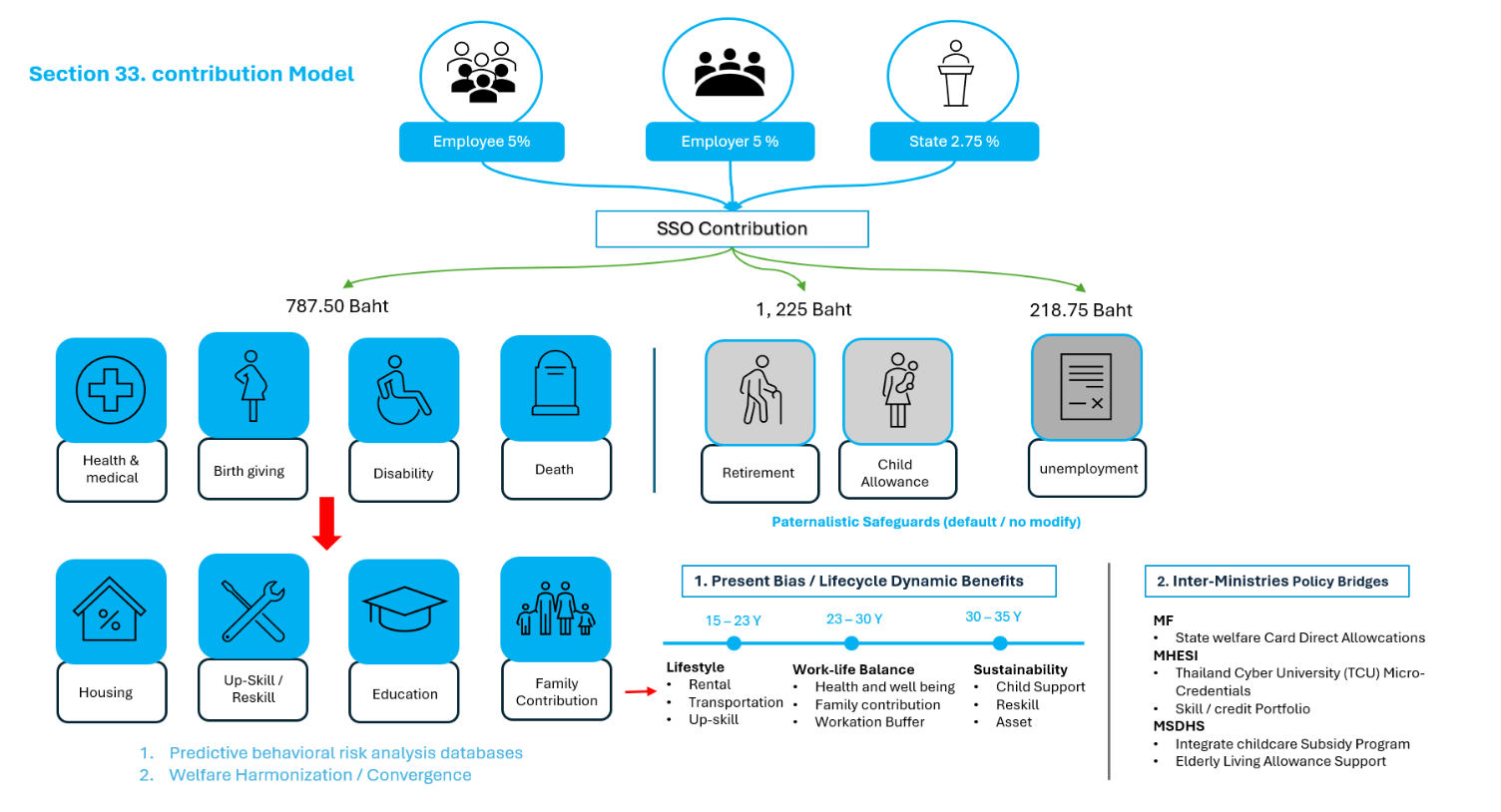
This pocket captures the short-term tripartite contribution allocation of 1.5% (totaling 4.5% of insurable earnings when matched by employee, employer, and the state). The Flexi-Pocket introduces an Active Choice Architecture with an annualized enrollment window. Workers with verified alternative private or corporate health insurance can actively opt out of redundant healthcare coverage and redirect their allocations into customized, present-survival sub-pockets (e.g., transportation benefit, rental deposits, or upskilling vouchers).
To align present needs with future pension adequacy, the system operates on the 3-Year Flexi Capsule Dual-Track Pension mechanism:
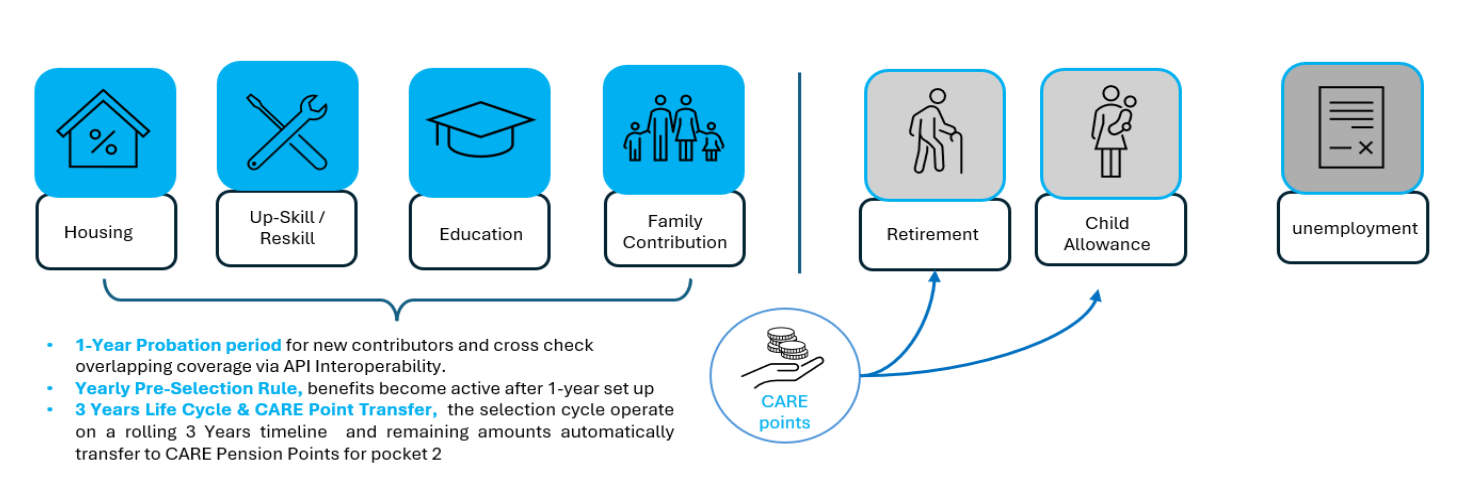
- The Behavioral Accumulation Phase (Years 1–3): Participants must complete a 1-Year Mandatory Probation Period of continuous contributions before unlocking customization rights, eliminating systemic adverse selection. Once unlocked, participants can roll over unused allocations within their Flexi-Pocket for up to 36 months to meet medium-term lifecycle constraints (such as saving for a housing deposit or career transition).
- The Automated Enforcement Phase (End of Year 3): If a portion of the Flexi-Pocket remains unspent at the conclusion of the 3-year cycle, an automated choice default triggers an Auto-CARE Transfer. The system sweeps the accumulated short-term surplus directly into the long-term benefit pool (Pocket 2). Rather than applying a flat-rate point system, these funds are integrated into the CARE formula as a Relative Performance Bonus, multiplying the worker’s future monthly pension yields.
3.2 Pocket 2 & Pocket 3: The Core Safe Zone (Paternalistic Safeguards)
- Pocket 2: Core Pension and Child allowance (3.0% Tripartite base) remains strictly locked under state paternalism and cannot be modified or opted out of, safeguarding baseline retirement dignity.
- Pocket 3: Unemployment (0.5% Tripartite base) is completely isolated. Keeping Pocket 3 isolated ensures that baseline actuarial calculations for lifelong payouts remain insulated from short-term behavioral manipulation.
Key Strategic Policy Mechanisms
The proposed CARE-Flexi-Pocket integration operates on three groundbreaking administrative mechanisms that shift the relationship between the state’s fiscal solvency and individual accountability.
The Predictive Behavioural Risk Analytics Database
Rather than remaining a static administrative ledger, the segmented choice architecture is transformed into an active, data-gathering engine. As users dynamically select, customize, or opt-out of specific short-term benefits over time via their Flexi-Pockets, the platform’s backend database aggregates these real-time longitudinal choices.
By applying machine learning models to these continuous behavioral data streams, the system constructs a dynamic national risk-profiling matrix. This database flags emerging socio-economic vulnerabilities based entirely on choice architecture trends (e.g., identifying sub-populations who repeatedly drain maximum flexi-benefits or consistently forfeit baseline protections for immediate consumption). This behavioral tracking exponentially enhances the state’s predictive capacity, allowing government agencies to identify at-risk populations and deploy essential targeted assistance before these individuals fall into absolute poverty (Poonpolkul et al., 2023).
Conclusion and Recommendations
The architecture of this framework relies on behavioral economics to alter financial habits without removing traditional state safety nets. By introducing controlled financial friction, voluntary micro-saving incentives, and predictive data collection loops, the system shifts the institutional role of social security from a rigid collection agency into an active financial partner—successfully aligning individual present-day utility with long-term macroeconomic stability.
To successfully operationalize this framework, the state must prioritize four strategic imperatives:
- Mandate Digital Hybrid Wallets via One-Stop FinTech Integration: Redesign the SSO digital infrastructure to structurally bifurcate contributions into clear, behaviorally labeled mental accounts. Integrate the hybrid wallet directly into existing, widely adopted national digital transaction architectures—specifically leveraging the Ministry of Finance’s secure Paotang or Thang Rat application infrastructures—to roll out this choice architecture with near-zero additional technology development costs, maximizing public cost efficiency.
- Deploy Segmented Risk-Profiling Gates via API Interoperability: Establish secure, real-time data integrations between the SSO platform, the Office of Insurance Commission (OIC), private insurance consortiums, the national civil registry (DOPA) and companies. This automated choice architecture instantly screens and segments Section 33 contributors. It hard-locks essential healthcare and disability coverage for vulnerable demographics lacking alternative safety nets, while seamlessly granting customization and opt-out autonomy to workers with verified private or corporate group insurance.
- Enact the 3-Year Auto-Forward Rule with Capital Safeguards: Institutionalize the 3-Year Flexi Capsule mechanism to automatically sweep unspent short-term allocations into core pensions, rewarding delayed gratification. Concurrently, retain the 30% Central Reinsurance block in high-yield national infrastructure bonds, utilizing the interest spread to finance macro-solvency while returning 100% of the principal to the user’s pension points.
- Leverage Predictive Lifecycle Analytics for Proactive Governance: Integrate mandatory, scenario-based age-based lifecycle pop-ups at key age milestones (25, 31, and 35) directly into the user interface. By cross-referencing real-time benefit shifts with these pop-up surveys, the Ministry of Finance and public educational institutions can identify localized economic crises, housing precarity, and skills mismatches years before they escalate, transforming the SSO into a Predictive National Labor Analytics Engine.
References
[1] Bank of Thailand. (2024). Thailand Financial Report 2024. Bangkok: Bank of Thailand.
[2] Chankhanti, W. (2020). Structural overlaps in the Thai health welfare state: A comparative analysis of SSO and UHC. Bangkok: Thammasat University Press.
[3] Kahneman, D., & Tversky, A. (1979). Prospect theory: An analysis of decision under risk. Econometrica, 268-291.
[4] Kydland, F., & Prescott, E. (1977). Rules rather than discretion: The inconsistency of optimal plans. Journal of Political Economy, 473-491.
[5] Mahosot, S. (2025). The effect of being an insured person under Section 39 on old-age pension benefits. TRUHU Social Journal, 3(1), 45-59.
[6] Poompokul, P., Porapollarm, P., & Wasi, N. (2023). Aging, inadequacy, and fiscal constrint: The case of Thailand. International Studies of Economics, 16(1), 36-67.
[7] Thaler, R. (1981). Some empirical evidence on dynamic inconsistency. Economics Letters, 201-207.
Download full article: Click