
Negotiating Safe Access: Policy Pathways to Childhood Immunization for Undocumented Myanmar Migrant Children in Mae Sot

Author: Aung Khant
Advisor: Ora-orn Poocharoen
Co-advisor: Phyu Phyu Thin Zaw
EXECUTIVE SUMMARY
Following the military coup in Myanmar in 2021 and the subsequent influx of undocumented Myanmar migrants into Thailand, access to essential childhood immunization under Essential Program on Immunization (EPI) among undocumented Myanmar migrant children in Mae Sot is present, but fragmented and conditional. It does not only involve health sector, instead it is a multi-sectoral issue. Documentation requirement, legal-mobility and language barriers continue to shape access as before 2021. However, enhancing access to EPI is essential to prevent vaccine-preventable diseases, not only for the well-being of undocumented Myanmar migrant children but also for Thailand’s national health security. Therefore, undocumented Myanmar migrant children should be explicitly accounted for in national and provincial EPI planning. Safe access pathways to EPI providers should also be established. Finally, selected migrant learning centers should be recognized as temporary EPI access points to expand coverage area of EPI services.
Keywords: immunization, vaccination, EPI, essential program on immunization, expanded program on immunization, undocumented migrant children, Thailand-Myanmar border, Mae Sot
PROBLEM STATEMENT
Historical cross-border movements between Thailand and Myanmar have been observed for several decades. It is driven by seasonal workforces, which enables Myanmar migrants to engage in seasonal work under the Border Pass scheme, and forced displacements, which has continued since 1980s. People seeking a refuge in Thailand settle either as camp refugees or as urban refugees/asylum seekers, whereas the latter falls into the category of “irregular, or undocumented status”. The irregular movements are shaped by several key drivers. Firstly, some seasonal workers choose to remain and work in Thailand beyond the validity of a border pass and become undocumented. Secondly, regular migrants under the Memorandums of Understanding (MoUs) scheme also opt to stay and work irregularly in Thailand because of high costs and complexity of the MOU process.[1] These irregular movements have escalated following the political unrest in Myanmar in February 2021. As of July 2024, IOM Thailand reported that there are at least 1.7 million Myanmar migrants in irregular situations.[2]
Undocumented migrants also bring along, or give birth to their children in Thailand, whose legal status also aligns with their parents. The Ministry of Interior (MOI) of Thailand has estimated that the number of children registered as stateless has increased significantly from 165,713 in 2022 to 171,635 in 2023, with Tak province recording the highest number across both years.[3] These children have been granted basic health rights by the Royal Thai Government; however, several challenges such as fear of being arrested by the authorities and discrimination by the healthcare staff are still being reported. This policy gap could have a significant impact on access to basic health care including EPI services for undocumented migrant children. It consequently raises an important concern of outbreaks of vaccine-preventable diseases for well-being of undocumented children and Thailand’s national health security. The Ministry of Public Health (MoPH) of Thailand reported measles outbreaks in temporary shelters in border provinces in 2012.[4] It underscores the importance of revisiting this issue, and ensuring to enhance access to EPI for undocumented Myanmar migrant children. Therefore, this policy brief aims to identify stakeholders, analyze barriers and facilitators for access to EPI, and recommend policies to promote safe and equitable access to EPI for undocumented Myanmar migrant children.
POLICY ANALYSIS
Methodology
A qualitative research design was used to examine access to EPI among undocumented Myanmar migrant children in Mae Sot after 2021. Interviews with relevant stakeholders were conducted between December 2025 and March 2026. Additionally, desk review, including meeting reports, annual reports, policy documents and organizational websites, was deployed to support stakeholder analysis. This study utilized Narrative Policy Framework[5] and Levesque’s Access to Healthcare Framework[6] (see Appendix A) as analytical lenes to both preserve how participants describe their experiences and identify patterns across cases.
Findings and discussion
The findings suggest that access to EPI for undocumented Myanmar migrant children in Mae Sot is present, but fragmented. Access is shaped by many actors, and extends beyond health sector – involving national security, foreign diplomacy, national priorities and political dynamics. At the same time, significant influence lies with non-health actors. Within health sector itself, formal actors such as MoPH hold greater influence while the highest stake lies with undocumented children and their caregivers. Alternative EPI providers and NGOs, although less powerful, play an important role in enabling access in practice. This means that those who are most affected have limited influence, while those who can influence policy may not directly experience the barriers. This helps explain why access to EPI is fragmented and conditional. It underscores that improving access to EPI requires more than recognizing the problem; it requires bringing relevant stakeholders together for deliberative discussions on safe and inclusive access to EPI. This direction is also consistent with the “Border Health Connectivity” initiative, which emphasizes coordination and dialogue around border health.[7]
Undocumented children and their caregivers face multiple, overlapping barriers that limit access to EPI. At the system level, undocumented children are often not accounted for in national planning, which affects the availability of formal EPI services, despite its significant implications for health of undocumented children and Thailand’s national health security. Institutional barriers arise from documentation requirements, such as Thai birth registration, which again limit the availability of formal EPI services. Language barriers also lead to communication problems at formal EPI providers, making it difficult for undocumented children and their caregivers to navigate, and engage with EPI services. At individual level, legal-mobility constraints such as fear of arrest, difficulty to commute and long distance to EPI providers are encountered, and negatively affect children and their caregivers’ ability to reach services. It can be concluded that Thai birth registration appears to be an important facilitator for access to formal EPI services. However, a previous study in 2021 shows that only a half of migrant children born at a hospital in Thailand were provided with a birth certificate.[8]Subsequently, these barriers have remained unresolved after 2021; they are structural rather than temporary and require policy-level responses to ensure safe and inclusive access to EPI services.
In response to above constraints, undocumented children and their caregivers rely on alternative EPI providers such as Mae Tao Clinic, Shoklo Malaria Research Unit and Madinah clinic. These providers offer EPI free of charge and without documentation requirements, and language barriers are overcome. The alternative providers therefore improve availability, affordability and ability to engage with EPI services. At the same time, community networks including peer support help caregivers identify where EPI services are available, enhancing ability to perceive EPI services as an accessible option. Some NGOs provide support with obtaining Thai birth registration, which facilitates access to formal EPI services. Coordination and advocacy efforts by Thai universities and academic researchers also play an important role in shaping access to EPI as they are better positioned to raise this issue within Thai policy space.
POLICY RECOMMENDATIONS
Account for undocumented Myanmar migrant children in national and provincial EPI planning
Immunization of undocumented Myanmar migrant children is not sufficiently accounted for in national and provincial EPI planning. This affects allocation of resources, including human resources, as well as coordination with international partners. Therefore, national and provincial EPI planning should explicitly include undocumented children.
The responsible agencies include the National Security Council (NSC), MoPH and Tak provincial health office (PHO). The NSC should help place this issue on the national policy agenda because it intersects with national security, border governance and health security. The MoPH should act as the main technical agency for translating this direction into EPI planning, while Tak PHO should coordinate implementation with district hospitals, alternative EPI providers and other NGOs.
This initiative will help ensure safer and more inclusive access to EPI for undocumented children. It also demonstrates Thailand’s commitment to protection of child’s rights as a signatory to the United Nations Convention on the Rights of the Child.[9] Even more, it generates a positive externality for Thailand’s national health security by preventing vaccine-preventable diseases. It can also create more deliberative discussions and well-linked collaboration among responsible agencies and international partners.
Regarding political feasibility, this initiative could be implemented under humanitarian aid, human rights, and child’s rights, minimizing political sensitivity. In terms of administrative feasibility, coordination between formal and alternative EPI providers has already been established under Tak Border Health Learning Center, which links Mae Sot General Hospital, Mae Tao and SMRU.[10] At the same time, funding and technical supports could be secured from Gavi, through WHO, UNICEF, UNOPS and other NGOs.[11], [12], [13], [14]
Establish safe access pathways to EPI providers
Undocumented children and their caregivers face legal-mobility barriers such as fear of arrest due to security checkpoints located at or near EPI providers. This undermines the right to health, which is a fundamental part of human rights, and limit undocumented children’s ability to reach EPI services.[15] Therefore, safe access pathways should be established for undocumented children and their caregivers travelling for EPI services. Security checkpoints should not be placed in ways that deter access to EPI providers, and individuals travelling for a clear immunization purpose should not be arrested on their way to and from EPI services.
The primary responsible agency is MOI, in coordination with provincial and local administrative authorities. The purpose of travel could be verified through immunization records, appointment slips and referral notes. EPI providers should also ensure that children receive immunization records or appointment documents after receiving services. This initiative would reduce legal-mobility barriers and make access to EPI providers safer and more predictable.
From border security perspective, ongoing undocumented migration and online scammers may strengthen the enforcement of security checkpoints. However, this proposal does not remove immigration control, instead, it only creates an exemption for undocumented children and their caregivers seeking EPI services. In terms of administrative feasibility, it does not require a new administrative structure. Regarding financial feasibility, the cost is low because it mainly requires coordination, communication and clear documentation rather than additional service infrastructure.
Expand service coverage by recognizing selected migrant learning centers (MLCs) as temporary EPI access points
Another way to tackle legal-mobility barrier is to expand service coverage area by recognizing selected MLCs as EPI access points for school-based immunization programs. MLCs can act as an assembly point for undocumented Myanmar migrant children, and some NGOs already provide transportation to and from MLCs. A previous MLC-based immunization program implemented by SMRU, in collaboration with Tak PHO and Mae Sot General Hospital, already showed that this approach increases immunization coverage among migrant children.[16] This would reduce the need for undocumented children and their caregivers to travel long distances to EPI providers and would make access safer and more predictable.
The responsible agencies include MoPH and Tak PHO, in coordination with MoE, selected MLCs, alternative EPI providers and other NGOs. In terms of administrative feasibility, selected MLCs could be recognized by MoPH as temporary EPI access points without requiring full recognition of MLCs as formal education institutions. This requires coordination with MoE because MLCs are not formally recognized and do not possess legal institutional status. The human resources gap could be addressed by recruiting qualified medical personnel displaced from Myanmar to support EPI delivery under structured supervision and coordination with local public health authorities and existing alternative EPI providers. Technical and funding support could also be secured from Gavi, through WHO, UNICEF, UNOPS, and other NGOs. This initiative would expand service coverage, reduce legal-mobility and language barriers, and improve access to EPI for both children enrolled in MLCs and children outside MLCs.
References
- (n.d.). Retrieved from UNICEF: https://www.unicef.org/immunization
- (2021, February 26). Retrieved from UNOPS: https://content.unops.org/documents/libraries/press-releases/2021/en/Press-release_GAVI-UNOPS-MoU_EN.pdf
- (2026, March 25). Retrieved from Gavi The Vaccine Alliance: https://www.gavi.org/about-us/our-partners/world-health-organization
- (n.d.). Biennial Report 2023-2024. Mae Tao Clinic. Retrieved from https://drive.google.com/file/d/1wJ9ZEnkS_MMpelhNEQl4RtzrT_3WWyKs/view
- (2025). Deliberative Process to Develop an Action Plan for the Development of Northern Border Village Areas (Episode 3). Chiang Mai University, School of Public Policy. Retrieved from https://spp.cmu.ac.th/%E0%B9%82%E0%B8%84%E0%B8%A3%E0%B8%87%E0%B8%81%E0%B8%B2%E0%B8%A3%E0%B9%80%E0%B8%8A%E0%B8%B7%E0%B9%88%E0%B8%AD%E0%B8%A1%E0%B9%83%E0%B8%88%E0%B8%8A%E0%B8%B2%E0%B8%A2%E0%B9%81%E0%B8%94%E0%B8%99-ep3/
- IOM Thailand. (2025, January). Overview of Myanmar Nationals in Thailand. Migration Data and Research Unit. Retrieved from https://thailand.iom.int/publications
- IPSR. (2021). An Assessment of Access to Birth Registration among Migrant Children: The Quantitative Study.Mahidol University, Institute for Population and Social Research (IPSR). Retrieved from https://www.unicef.org/thailand/reports/assessment-access-birth-registration-among-migrant-children
- Jones, M. D., & McBeth, M. K. (2010). A Narrative Policy Framework: Clear Enough to Be Wrong? The Policy Studies Journal, 38(2).
- Kaji et al. (2015, October 19). Immunization Coverage in Migrant School Children along the Thailand-Myanmar Border. Journal of Immigrant and Minority Health. https://doi.org/10.1007/s10903-015-0294-x
- Levesque et al. (2013). Patient-centred access to health care: conceptualising access at the interface of health systems and populations. International Journal for Equity in Health. https://doi.org/10.1186/1475-9276-12-18
- (2025). Meeting Summary: Exploratory Consultation and Strategic Discussions on Expanding Vaccination Coverage in Myanmar.
- OHCHR. (2008, June). Retrieved from The Office of the High Commissioner for Human Rights (OHCHR): https://www.ohchr.org/sites/default/files/Documents/Publications/Factsheet31.pdf
- United Nations Network on Migration. (2024). Thailand Migration Report 2024. Retrieved from https://thailand.iom.int/resources/thailand-migration-report-2024
Appendix A: Levesque’s Access to Healthcare Framework
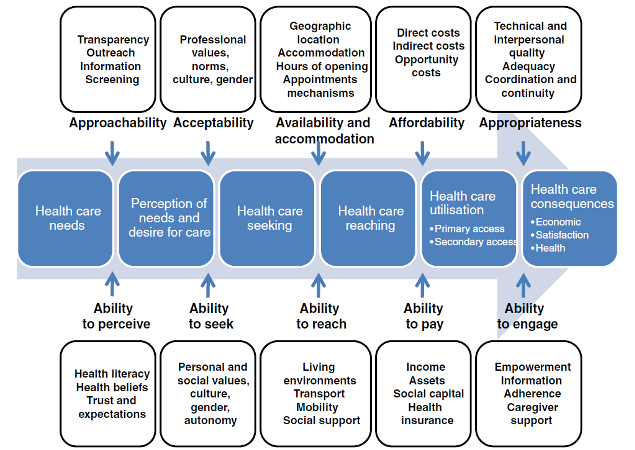
Source: Levesque et al. (2013)
Note:
[1] (United Nations Network on Migration, 2024)
[2] (IOM Thailand, 2025)
[3] (United Nations Network on Migration, 2024)
[4] (Kaji et al., 2015)
[5] (Jones & McBeth, 2010)
[6] (Levesque et al., 2013)
[7] (“Deliberative Process to Develop”, 2025)
[8] (IPSR, 2021)
[9] (United Nations Network on Migration, 2024)
[10] (“Biennial Report 2023-2024”)
[11] (Gavi The Vaccine Alliance, 2026)
[12] (UNICEF, n.d.)
[13] (UNOPS, 2021)
[14] (“Meeting Summary: Exploratory Consultation”, 2025)
[15] (OHCHR, 2008)
[16] (Kaji et al., 2015)
Download full article: Click