
The Impact of Policy Fragmentation in China's New Energy Vehicle Power Battery Recycling on Transportation Transformation: A Marxist Theoretical Analysis.

Author: Rui Duan
Advisor: Thida Chaiyapa
Executive Summary
Power battery recycling is rapidly emerging as a critical governance bottleneck in China’s green transition. With the national “dual carbon” strategy (carbon peaking by 2030 and neutrality by 2060) accelerating low-carbon reforms, the number of new energy vehicles (NEVs) surpassed 30 million in 2024, generating 580,000 tonnes of retired batteries in that year alone. These batteries contain valuable resources such as lithium, cobalt, and nickel, and improper disposal risks severe soil contamination, resource depletion, and supply chain disruption. From 2012 to 2025, the central government released 30 national-level policy documents aimed at establishing a unified, efficient, and closed-loop recycling system. However, persistent implementation gaps reveal a highly fragmented governance landscape.
This policy brief addresses a central question: Why does battery recycling governance remain fragmented despite clear national strategic goals? Drawing on a mixed-methods approach—including policy text content analysis and provincial case studies (Sichuan, Guangdong, and Zhejiang)—the brief identifies three structural misalignments: vertical disconnection between central and local governments, horizontal inconsistency across ministries, and regional fragmentation driven by provincial protectionism. Applying Marxist interest theory, the analysis further explores how structural conflicts among key actors—central versus local authorities, formal versus informal enterprises, and state versus public interests—have contributed to systemic disintegration and weakenforcement capacity.
The findings suggest that institutional fragmentation in battery recycling is not merely an issue of administrative inefficiency but reflects deeper contradictions in China’s political economy of green development. Without institutional synergy, incentive realignment, standard unification, and global integration, China risks falling into a “policy without implementation” trap—ultimately undermining the foundations of its ecological governance and international leadership in sustainable energy transitions.
I. Why Battery Recycling Fragmentation Threatens China’s Green
Transition: A Political Economy Perspective
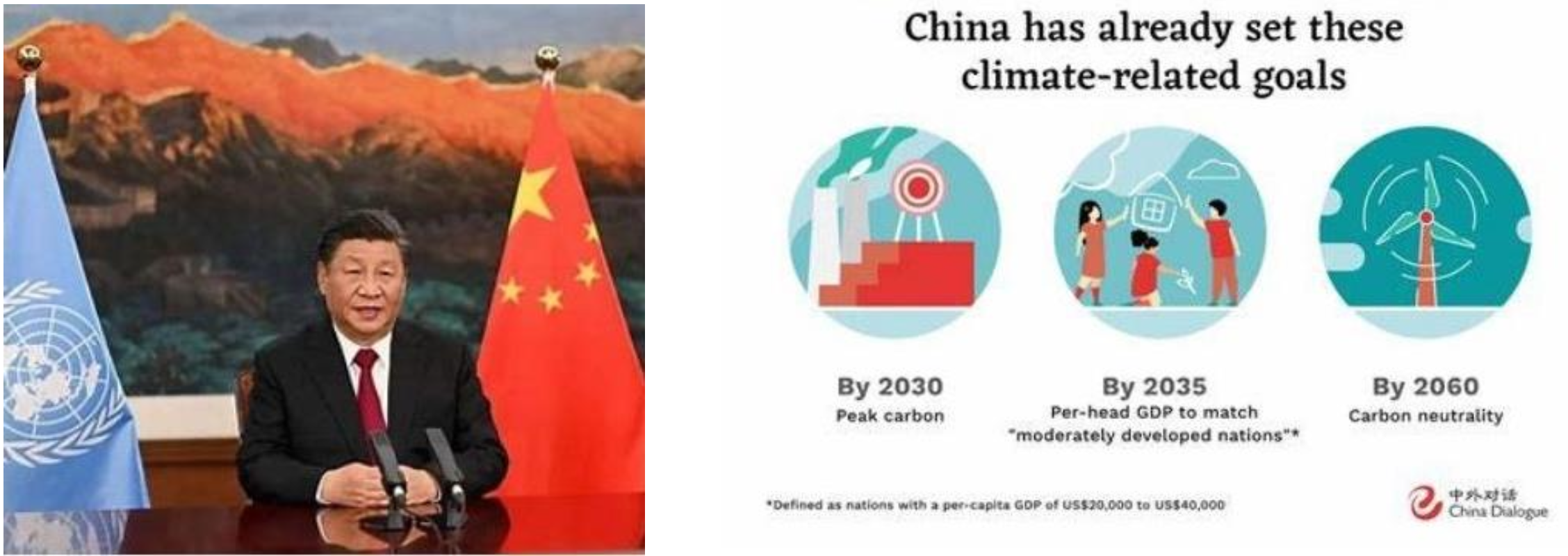
In 2020, President Xi Jinping made a historic commitment to the world: China would peak its carbon emissions by 2030 and achieve carbon neutrality by 2060. This “dual carbon” vision fundamentally reshaped the country’ s development logic, placing environmental sustainability at the heart of economic reform. One of the key levers for this green transformation lies in the transportation and energy systems. With strong national backing, China’s new energy vehicle (NEV) sector has experienced explosive growth, reaching 30 million vehicles by 2024 and dramatically reducing fossil fuel dependence.
Yet this green triumph has brought with it a looming crisis. By 2024, over 580,000 tonnes of power batteries retired, generating significant risks of soil contamination, heavy metal leakage, and strategic resource insecurity. Without a robust recyclinginfrastructure, these batteries—rich in lithium, cobalt, and nickel—threaten not only ecological integrity but also national supply chains.
To respond, the Chinese government has made power battery recycling a regulatory priority over the past decade. From 2012 to 2025, 30 national-level policy documents were issued by key ministries—including the Ministry of Ecology and Environment (MEE), the Ministry of Industry and Information Technology (MIIT), and the National Development and Reform Commission (NDRC)— to promote a closed-loop, standardised recycling system.
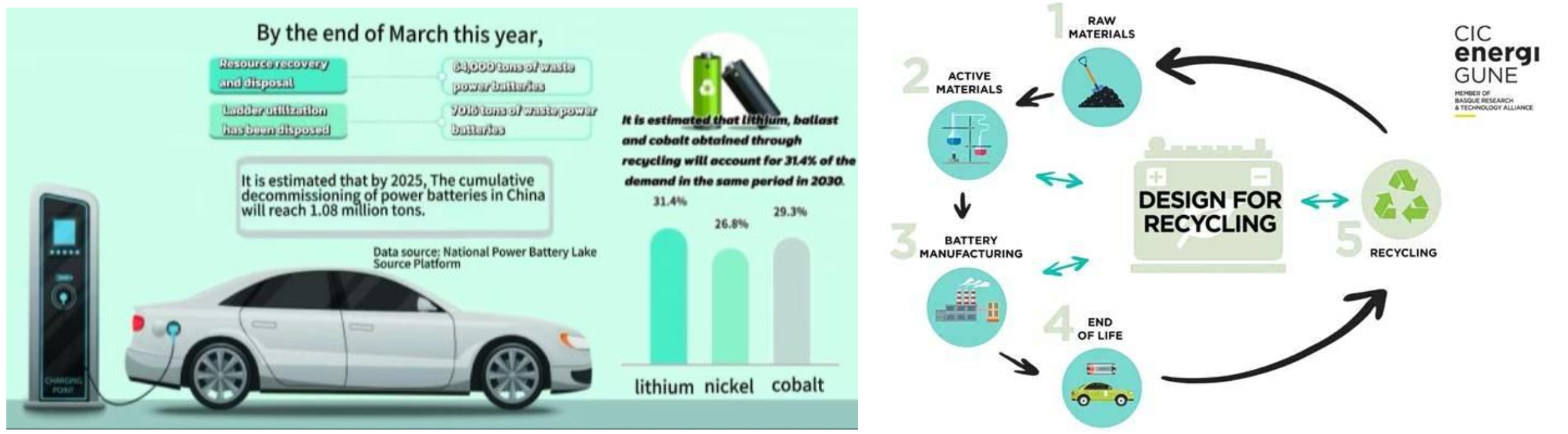
However, implementation has not matched ambition. In 2024, only 30% of retired batteries entered formal recycling channels, while the rest flowed into low-cost, informal markets. Illegal dismantling services, charging as little as ¥300 per ton, severely undercut formal recyclers whose costs can reach ¥4,200 per ton. Weak enforcement, vague incentives, and overlapping mandates have allowed illicit actors to thrive. In recent statements, the State Council identified battery recycling as a “key bottleneck” in China’s green transition, emphasising the need for “ full-chain management and cross-departmental coordination.” Academic research echoes this concern, consistently highlighting institutional fragmentation as a significant obstacle.
This chapter provides a structural analysis of such fragmentation, based on a longitudinal policy review and guided by a multi-level governance lens.
II. Policy Analysis1.
Understanding Fragmentation: Governance Layers and Misalignment
China’s battery recycling governance suffers from fragmentation across three dimensions. Vertical misalignment reflects a tension between national strategy and local economic logic. The central government promotes long-term goals such as carbon neutrality and cascade utilization. However, local governments often prioritize short-term fiscal gains. For example, Sichuan’s 2025 Interim Measures mandate in-province dismantling to protect its lithium industry, which contributes 15% of local tax revenue and 8% of employment. This undermines the national “cascade first” principle. As a result, only 12% of Sichuan’s retired batteries enter formal cascade channels, while over 80% are diverted through informal cross-provincial flows. This conflict reveals how GDP-driven local performance metrics structurally clash with centralized ecological priorities.
Horizontal fragmentation arises from inter-ministerial conflict. MIIT and MEE apply inconsistent standards to retired batteries. MIIT defines them as “general commodities” to promote reuse, while MEE categorizes them as “hazardous waste,” requiring stringent permits. These contradictions create regulatory ambiguity and inflate compliance costs. A Guangdong-based recycler with a 10,000-ton annual capacity reported costs rising from ¥28 million to ¥42 million due to dual regulatory burdens. The absence of cross-ministerial coordination reflects the siloed nature of China’s bureaucratic structure, weakening horizontal governance coherence.
Regional fragmentation is driven by provincial competition for prestige and control. Provinces roll out their own digital platforms, standards, and incentive schemes, often at odds with national efforts. Zhejiang, for instance, invested ¥300 million in a blockchain-based “battery bank” platform. Yet its interoperability with the national system remains below 30%, causing interprovincial transaction delays of up to 45 days. Guangdong’s whitelist policy restricts market access for non-local recyclers, delaying the expansion of major national players like CATL and GEM. These actions echo Olson’s theory of collective action failure, where actors pursue narrow local gains at the cost of system-wide efficiency.
These multi-layered failures point to a deeper structural issue. China’s battery recyclingsystem is fragmented not just due to bureaucratic inefficiencies, but because of entrenched conflicts between institutional actors with competing interests. This fragmentation is not merely technical; it is political.
2. Interest Structure and Conflict Analysis: A Marxist Interpretation of Policy
Fragmentation
China’s fragmented battery recycling governance is not merely the result of administrative inefficiency—it reflects deeper structural tensions rooted in Marxist class interest theory. Central authorities, local governments, and different categories of enterprises all operate based on conflicting material interests. At the same time, the general public remains largely excluded from the policy design process, leading to governance misalignment at every level.
2.1 Divergent Goals and Class Interests: A Realistic Projection of Power
At the national level, the central government—representing state capital—prioritizes strategic long-term goals like carbon neutrality and resource security. This is embodied in policies such as the Administrative Measures for the Stepwise Utilisation of Power Batteries (MIIT, 2021), which require at least 60% of retired batteries to be directed toward cascade use.
However, resource-rich provinces like Sichuan and Jiangxi—acting as agents of regional capital—pursue immediate economic gains by promoting in-province dismantling industries. For instance, Sichuan’s 2025 interim measures mandate local processing to protect its lithium industry, which contributes 15% of tax revenue and 8% of employment. This has significantly raised compliance costs for CATL’s local base in Yibin and delayed the establishment of a national cascade network. The tension between central policy goals and regional self-interest reveals a fundamental verticalconflict between capital accumulation at different scales.
Enterprise behaviour further illustrates class logic in fragmented governance. As production-end capital, CATL and similar battery manufacturers must absorb high costs to meet Extended Producer Responsibility (EPR) standards—about ¥4,200 per ton. In contrast, application-end capital like BYD and NIO face fewer direct dismantling obligations but still incur an added ¥500–¥800 per vehicle to develop recycling systems. For small and medium-sized NEV producers, these costs are unsustainable—pushing them to partner with informal recyclers, whose cost is only a third of the formal route. These decisions, while rational from a profit-maximization standpoint, undermine formal recycling channels and amplify policy distortion.
At the bottom of the hierarchy, the **public—representing the proletariat—**faces a mismatch between institutional logic and survival needs. After factoring in logistics and testing, formal recycling systems only offer ¥150–¥200 per battery pack, while informal channels can pay ¥200–¥300. With no financial or behavioral incentives, nearly 70% of consumers prefer the black market (China Automotive News, 2024). This reflects what Marx described as the contradiction between “state planning” and “mass survival”—a clear case where policies neglect the economic rationality of the working class.
2.2 Institutional Logic of Conflict: Interest Differentiation in Action
The “time contradiction” in capital accumulation further exacerbates policy fragmentation. Local governments—under GDP-driven evaluations—allocate up to 70% of subsidies toward short-term lithium extraction and processing projects. For example, Jiangxi’s investment in lithium carbonate refining delivers fast fiscal returns, while long-term cascade utilisation projects (which take 4–8 years to mature) are underfunded. This short-termism has caused CATL’s energy storage unit to reach only 45% of its planned scale by 2024, while NEV manufacturers are also 30% behind in recycling network construction (MIIT, 2024).
Class-based externalization of costs further deepens inequality. In 2024, the Ministry of Ecology and Environment reported illegal dismantling had polluted over 12,000 km² of farmland, yet rural enforcement coverage remained below 17%. Whileinformal actors evade responsibility, CATL and other formal enterprises must shoulder the remediation burden, amounting to ¥1.2 billion or 9.3% of net profits. This reflects Marxist critiques of capitalism’s logic of “socializing costs while privatizing gains”.
Technology, ideally a neutral enabler, has become another site of interest conflict. CATL’s ¥300 million blockchain traceability platform, which achieved national full-chain coverage in 2023, has less than 30% interoperability with provincial systems like Zhejiang’s “Zhe Li Recycling.” Due to local mandates requiring “local data storage,” cross-provincial battery transfers now face 30-day re-approval cycles. Rather than facilitating integration, digital infrastructure has been captured by local governments as a tool for performance competition, confirming Marx’s insight that “technology under capitalism serves monopolistic control, not collective coordination.”

Key Finding
The core fragmentation in China’s battery recycling governance stems not from technical hurdles but from the structural contradictions between classes and forms of capital. Central and local governments compete for surplus value; production-end and application-end capital diverge in cost burdens and incentives; and the public, as the ultimate bearer of cost and environmental damage, remains voiceless in system design. These tensions are institutionalized in current governance structures and represent, as Marxism predicts, a systemic outcome of material interest conflicts under capitalist accumulation.
If fragmentation is to be resolved, reforms must go beyond efficiency-based fixes. China must rebuild its recycling governance with society’s long-term interests at thecentre—breaking the alliance between capital and power, ensuring that policy formation truly reflects public needs, and redesigning systems that address—not obscure—class contradictions.
3. Impact: Why Fragmentation Threatens China’s Green Transition
The consequences of this structural fragmentation are wide-ranging and dangerous. Technically, it leads to severe inefficiencies: China loses critical minerals like lithium and cobalt as formal recycling systems remain underutilized. This increases reliance on foreign imports, raising geopolitical risks and supply chain vulnerabilities.
Economically, the vast cost gap between formal and informal actors discourages investment in clean technologies. Illicit recyclers thrive by avoiding regulation, creating a race-to-the-bottom dynamic. Socially and environmentally, the public bears the brunt. Informal workshops are often located in underdeveloped rural areas, where pollution and labor exploitation are most severe. These practices reflect what Marx called the spatial expansion of alienated labor—where capital externalizes ecological and social costs to marginalized spaces.
These outcomes are not just policy failures; they signal a deeper legitimacy crisis. A green transition built on social inequality, institutional fragmentation, and ecological sacrifice is ultimately unsustainable. Thus, the third key finding is clear: fragmentation undermines not just efficiency, but also social equity, resource security, and environmental justice—foundations of a legitimate green transformation.
III. Policy Recommendations: Building a Coordinated and
Efficient Battery Recycling Ecosystem
To overcome fragmentation and stakeholder misalignment, China must build an integrated battery recycling ecosystem grounded in coordination、standardisation and aligned incentives. This ecosystem should place automakers at its core, actively engage consumers, and be anchored by strong institutional mechanisms. Below are four strategic directions with concrete proposals:
1. Institutional Design: Enhancing Central-Local Coordination
The first step is to reshape the coordination mechanism between central and local governments. The central government should establish binding national targets for battery repurposing and explicitly incorporate them into local performance assessments. Meanwhile, local governments should design implementation strategies that reflect their regional characteristics but remain aligned with national standards. A unified national information system is needed to consolidate battery flow data, enhance cross-provincial regulatory cooperation, and support real-time supervision.
Key Recommendation: Establish a central-local governance framework with clear vertical mandates, shared digital infrastructure, and standardized performance evaluation to ensure cohesive implementation.
2. Stakeholder Alignment: Reforming Incentives and Responsibilities
Aligning incentives across stakeholders is essential. Fiscal instruments should prioritize battery repurposing, particularly by supporting recycling infrastructure in underdeveloped regions through earmarked funds. Automakers’ recycling performance must be directly linked to their regulatory approvals and public procurement access to strengthen Extended Producer Responsibility (EPR). All 4S dealerships should be required to offer standardized battery collection services and integrate with the national recycling database. To boost consumer participation, government and enterprise actors should introduce trade-in rebates, point-based rewards, and after-sale service benefits tied to proper battery disposal.
Key Recommendation: Build a stakeholder-aligned incentive system combining automaker accountability, government subsidy mechanisms, and consumer engagement platforms.
3. Technological Innovation: Standardising and Scaling Key Technologies
Improving technological capacity is critical to reducing compliance costs and improving traceability. National R&D investment should prioritize safe disassembly, non-destructive testing, and battery identification technologies. At the same time, a harmonized set of technical standards should be issued for transport, certification, dismantling, and testing, reducing regulatory fragmentation. Lifecycle traceabilityplatforms—particularly those based on blockchain—should be promoted nationally to ensure data transparency and prevent information silos.
Key Recommendation: Promote a unified and scalable technology infrastructure that supports standard-compliant innovation, improves recycling traceability, and facilitates national-level adoption.
4. International Coordination: Enhancing Global Engagement
While China has established significant technological and policy advantages in power battery recycling, achieving a deeper green transition requires greater international alignment and multilateral cooperation. First, China should advocate for the development of internationally recognised certification systems for battery recycling projects. These certifications should incorporate standardised indicators, such as carbon footprint accounting, environmental compliance, and resource utilisation efficiency, enabling mutual recognition across countries. Second, China should leverage platforms such as the Belt and Road Initiative to foster cross-border regulatory cooperation and collaborative project deployment. By facilitating the “ tiered circulation” and “regional sharing” of retired batteries, based on different industrial needs and regional capacities, countries can collectively extend battery lifespans and optimise resource use. Shared data systems and interoperable traceability platforms will further enhance transparency, accountability, and environmental integrity throughout the battery lifecycle.
Key Recommendation: Promote internationally recognised certification mechanisms for battery recycling projects and strengthen multilateral partnerships to enable cross-border battery flow, lifecycle extension, and globally coordinated recycling governance.
Conclusion
Addressing policy fragmentation and conflicting stakeholder interests in China’s battery recycling sector is no longer an option—it is a strategic imperative. By fostering central-local coordination, enterprise-led responsibility, and active publicparticipation, China can build a recycling ecosystem that is not only efficient but also adaptive and inclusive.
The transition from fragmented and reactive governance to systematic, forward-looking institutional design will be essential in unlocking the full potential of battery resources, accelerating green industrial transformation, and fulfilling national decarbonization commitments.
A future-oriented, integrated approach to battery recycling will not only strengthen domestic circular economy capabilities but also position China as a global leader in sustainable energy transition governance.References
[1] CATL. (2024). Annual Report 2024. Contemporary Amperex Technology Co., Ltd.
[2] Marx, K. (1844/2007). Economic and Philosophic Manuscripts of 1844. Dover
Publications.
[3] Marx, K. (1894/1991). Capital: A Critique of Political Economy, Volume III (D.
Fernbach, Ed.). Penguin.
[4] Ministry of Ecology and Environment (MEE). (2024). China’s Power Battery
Recycling Data Bulletin. Beijing: MEE.
[5] OECD. (2023). Policy Tools and Gaps in Battery Recycling Governance: China
and Beyond. OECD Publishing.
[6] PricewaterhouseCoopers (PwC). (2024). China New Energy Industry Innovation
Report [R]. PwC Research Institute.
[7] Skeete, J.-P., Wells, P., & Dong, F. (2020). Battery waste, recycling, and
sustainability in the UK. Energy Research & Social Science, 69, 101581.
https://doi.org/10.1016/j.erss.2020.101581
[8] Zhou, L. A. (2007). Governing China’s local officials: An analysis of promotion
tournament model. Economic Research Journal, 7, 36–50.
[9] Guo, X. (2015). Legal issues on power battery recycling and utilisation (Doctoral
dissertation). Beijing Institute of Technology.
[10] International Energy Agency (IEA). (2023). Global EV outlook 2023 [R]. Paris: IEA.
[11] National Development and Reform Commission (NDRC). (2023, February 28). The
wave of power battery retirements is coming; establishing a scientific and standardised
recycling system is urgent [EB/OL]. Retrieved from
https://www.ndrc.gov.cn/wsdwhfz/202302/t20230228_1350052_ext.html
[12] Fujian Provincial Department of Industry and Information Technology. (2024, May 29).
Battery recycling focuses on establishing standard systems [EB/OL]. Retrieved from
https://gxt.fujian.gov.cn/zwgk/xw/hydt/xydt/202405/t20240529_6456888.htm
[13] People’s Daily. (2024, May 16). Power battery recycling industry accelerates [N].
People’s Daily (Page 07). Retrieved from
http://cpc.people.com.cn/n1/2024/0516/c64387-40237038.html
[14] National Business Daily. (2023, March 26). Economic Daily commentary: Building a
recycling system for new energy vehicle batteries [EB/OL]. Retrieved from
https://m.nbd.com.cn/articles/2023-03-26/2727696.html
[15] Winternitz, K., Heggie, M., & Baird, J. (2019). Extended producer responsibility
for waste tires in the EU: Lessons learnt from three case studies – Belgium, Italy
and the Netherlands. Waste Management, 89, 386–396.
https://doi.org/10.1016/j.wasman.2019.04.023
[16] China Society of Automotive Engineers. (2024). Research on technology and policies of
NEV power battery recycling [R]. Beijing: China Society of Automotive Engineers.
[17] Zero Point Data. (2024). Public awareness survey report on new energy policies [R].
Shanghai: Zero Point Data.
[18] Reference Net. (2022, January 25). Technical and policy analysis on recycling of waste
power batteries [J]. Retrieved from https://m.fx361.cc/news/2022/0125/9606912.html
Download full article: Click