
Cross-Border Policy Frameworks for Preventing Online Scams in Myanmar and Thailand: The Roles of Non-State Actors

Author: Naw Chit Su Win
Advisor: Piyapong Boossabong
Co-advisor: William Patrick Kittredge
Problem Statement
Online scam operations have become one of the fastest-growing forms of transnational organized crime along the Thai–Myanmar border, especially in Karen State. Karen State is one of the most politically complex states in Myanmar, with territory controlled by multiple armed actors. This fragmented system of governance has created opportunities for online scam operations to expand while making law enforcement and cross-border cooperation more challenging. Myanmar and Thailand have each implemented a range of robust laws and policies to tackle cybercrime and online scams; however, these criminal networks continue to expand and threaten global peace and security.
An online scam operation is like an iceberg. Financial losses and human rights abuses are only the visible tip, while deeper structural forces, including political instability, corruption, economic inequality, and the absence of the rule of law, remain hidden beneath the surface. These underlying conditions sustain and strengthen online scam networks. Understanding these hidden drivers is essential to addressing the full complexity of online scam operations.
The study identifies three key factors that drive the persistence of online scam operations. First, the absence of a joint cybersecurity policy framework and weak law-enforcement cooperation between Thailand and Myanmar result in limited information sharing, an inability to apprehend the main criminal, and a lack of accountability for human rights violations. Second, failure to prioritize criminal investigation and prosecution allows perpetrators to expand the scams further and operate them with minimal risk. Lastly, the lack of sufficient awareness and robust protection mechanisms for communities has allowed scams to become a global threat. A combination of these three factors, with political instability and powerful involvement of non-state actors, allows scam networks to operate with impunity.
Policy Analysis (Key Findings and Discussion)
To understand the root cause of persistent online scamming at the Thai-Myanmar border and to identify the factors limiting effective prevention, I have used Causal Layered Analysis (CLA), conducted in-depth interviews, and systematically reviewed and analysed relevant policies, laws, official statements, online news, reports, and online interviews of spokespersons from Thailand, KNU, BGF, DKBA, and the military junta of Myanmar.
1. Litany Level: Visible Problem and Public Narratives
At the visible level, online scams are often described as a serious transnational crime and a major security threat in the region. The Thai–Myanmar border, especially Karen State, is known internationally for scam compounds connected to human trafficking, financial fraud, forced labour, sexual exploitation, and organized crime. According to Global Anti-Scam Alliance (GASA) (2025), international scam losses were over $1 Trillion, and Thailand faces a scam crisis, with 115.3 billion baht (US$ 3.2 billion) lost in the past year. However, there is no data on the Myanmar case.
In 2025, Thailand strengthened its response through stricter cybercrime laws, financial monitoring systems, and launched the “all-out war on scammers” and collaborated with the EU, UN, China, and ASEAN, but scam networks still continue to grow. At the same time, Myanmar’s ongoing political instability and fragmented territorial control continue to weaken effective cross-border cooperation and accountability mechanisms. This demonstrates that online scams are not only a cybersecurity issue but also a major economic, social, and human security threat.
2. Systemic Causes: Structures/Institutions
At the systemic level, the findings demonstrate that the persistence of online scams is deeply connected to structural instability and fragmented governance systems in Myanmar following the 2021 military coup. The findings further reveal that scam operations are sustained through networks involving both state and non-state actors. Interview evidence and secondary sources indicate that the military junta, local armed groups, and business networks have enabled the construction and protection of scam compounds through profit-sharing arrangements, informal agreements, and corruption. The involvement of groups such as the BGF and DKBA has further complicated enforcement efforts in Karen State.
According to the NUG spokesperson (personal communication, May 13, 2026), “Throughout the period of military rule, the military has been closely involved in these businesses, both through share ownership and profit-sharing arrangements”. The Secretary of DIRA – KNU (personal communication, May 8, 2026) also states that financial transactions between scammers and high-ranking military officials have been documented, highlighting the depth of institutional corruption. Conversely, Major General Zaw Min Tun claimed that the KNU and PDF “provide protection to online scam and gambling business in return for financial benefit” (Kyaw Myo Min, 2025, 13:18).
Also, the findings prove that the prolonged civil war and economic collapse in Myanmar have created conditions where illicit economies become one of the few available livelihood opportunities. Many local people voluntarily join scam operations due to unemployment, poverty, and lack of stable income. As a result, online scam centres function not only as criminal enterprises but also as alternative economic opportunities within conflict-affected regions. The NUG spokesperson and the Secretary of DIRA – KNU highlight that persistent political instability and insufficient job opportunities make illicit activities one of the few ways for thousands of people to earn an income.
Another important structural challenge is the imbalance in technological and human resources. Scam networks operate with advanced digital technologies, sophisticated telecommunications systems, and substantial financial resources, while organizations such as the KNU and NUG face severe limitations in personnel, territorial control, and enforcement capacity.
The Secretary of DIRA – KNU (personal communication, May 8, 2026) states that although task forces exist at multiple administrative levels, operations in Brigades 6 and 7 are particularly hampered by the DKBA and BGF, who actively protect scam compounds. He (personal communication, May 8, 2026) also explained that “KNU plans to separate and manage the individuals involved systematically, but in reality, each compound contained 2,000-4,000 people,” and the operations overwhelm the limited personnel available and enforcement capacity. Similarly, the NUG spokesperson states that many scam compounds are located outside areas of the NUG’s control, and the NUG is also facing contested legitimacy.
Lastly, the lack of joint cybersecurity cooperation has made the situation worse. For example, Thailand has signed a Memorandum of Understanding (MoU) with Singapore to combat online scams, but it has not established a similar agreement with Myanmar. This gap weakens cross-border efforts to address online scam operations.
3. Worldview Level: Political and Ideological
At the worldview level, the findings show competing understandings of governance, legitimacy, and security. Under the military junta, cyber laws have increasingly been used as a tool of political control instead of a mechanism for civilian protection and accountability. Laws related to cybersecurity, telecommunications, and anti-money laundering are often weaponized to suppress opposition groups and restrict dissent.
Furthermore, the conflict economy has normalized relationships between armed actors, business interests, and illicit networks. On the Thai-Myanmar border, survival, job opportunities, and receiving basic needs are prioritized over legality. The Major General of the Karen BGF, Bo Chit Thu, said, “I joined the military at a young age after being denied the opportunity to receive an education. It is not wrong to want the country to develop, for the Karen people to live better lives” (The Nation Thailand, 2025).
Among many local media outlets, the Irrawaddy (2026) also highlights that the Karen BGF has built schools and hospitals for local people after the crackdown on scamming compounds in 2025. However, it remains unclear how much of these profits benefit local communities, and it raises a serious ethical dilemma.
The findings also reveal tensions between legitimacy and regional cooperation. Although the NUG and KNU actively seek collaboration with Thailand and international actors, formal government-to-government mechanisms remain limited because the military junta continues to hold international recognition within certain diplomatic frameworks. This weakens coordinated regional responses and reinforces fragmented governance systems along the border.
4. Myth and Metaphor Level: Deep Narratives Sustaining the Crisis
At the deepest level, several underlying narratives shape the persistence of online scams in the region. One dominant metaphor is that the Thai–Myanmar border is a “Lawless Gray Zone” where criminal economies thrive because governance is fragmented, conflict remains unresolved, and the rule of law is absent.
The Secretary of DIRA – KNU (personal communication, May 8, 2026) explained that while scammers were arrested, they “refused to return (home country), the DKBA was asked to come and take them. They were reportedly paid 100,000 kyats per person to pick them up.”
Another powerful narrative is “cybercrime cannot be eliminated during war,” which reinforces state and non-state actors toward enforcement efforts. The Secretary of DIRA – KNU (personal communication, May 8, 2026) said that “it is difficult to operate in the middle of the war,” and the NUG spokesperson (personal communication, May 13, 2026) also states, “The country is at war. During the revolutionary period, it was not easy to deal with these issues.”
This narrative normalizes the continuation of illicit economies and believes that the entrenched systems are protected by powerful state and non-state actors and are extremely challenging to dismantle.
Policy Recommendations
Recommendation for the Karen National Union
For Immediate Action
- Establish a comprehensive telecommunications and cybersecurity policy and strategy with digital experts, including mandatory registration and monitoring of Wi-Fi networks, Starlink systems, electricity access, and telecommunications infrastructure to track online scam activities and support legal enforcement. Also, an awareness-raising strategy on cybercrime, human trafficking, and digital security should be strengthened.
- Review and update land and investment policies to prevent investments linked to scam operations, and strengthen border inspections, identity verification, legal accountability mechanisms, and clear distinctions between victims and perpetrators are necessary to ensure justice, the rule of law, and effective anti-scam enforcement in Karen State.
- KNU should initiate formal dialogue and establish common agreements with the BGF/KNA, DKBA, and KNU/KNLA-PC to dismantle online scam operations.
- Enhance intelligence-sharing and joint investigations with the FBI and international cybercrime task forces.
- Throughout this implementation, KNU and all actors need to integrate gender-sensitive approaches and gender-responsive budgeting into anti-scam and rehabilitation policies and strategies.
For Long-Term Action
- Promote sustainable economic alternatives by developing legal markets, employment opportunities, and ensuring local people have access to essential basic services through coordination with Karen CSOs and economic development specialists.
- To reduce dependence on illicit economies, strengthen community resilience, and create long-term social and economic stability, KNU needs to ensure the local people have reliable access to basic public services, including employment opportunities, education, healthcare, and community development programs.
Recommendations for the Federal Government of Myanmar
For Long-Term Action
The recommendation is intended to be considered in the cyber policies and strategies to be established by the federal government of Myanmar.
- Undertake comprehensive reform of its Cyber Security Law, Electronic Transactions Law, Telecommunications Law, and Anti-Money Laundering Law, in collaboration with digital and cyber specialist organizations, to ensure civilian protection, digital rights, and true accountability.
- Develop and implement a comprehensive National Cybersecurity Strategy with federal states/units.
- Future policy development also should adopt a bottom-up approach, actively incorporating input from state and non-state actors, civil society organizations, and local communities. This inclusive process will address the persistent shortcomings of top-down policymaking and foster more lasting, equitable solutions.
Recommendations for the Government of Thailand
For Immediate Action
- Recognize the KNU and NUG as primary partners in combating online scams and human trafficking, especially since the military junta, BGF, and DKBA are both sanctioned and deeply implicated in these illicit operations.
- An effective cross-border policy framework should establish a joint data-sharing platform, a unified monitoring center, and enhanced law-enforcement collaboration.
- Provide technical support and share best practices with the KNU and NUG, who uphold international standards and are actively engaged with Thai authorities.
Recommendations for ASEAN and the United Nations
For Immediate Action
- Recognize the KNU and NUG as primary partners in combating online scams.
- Provide comprehensive technical, cybersecurity, human resource, and financial support to KNU, NUG, and PDF in Karen State. The technology and infrastructure wielded by scammers are extremely advanced, demanding equally sophisticated resources to counter their operations. Only decisive, well-coordinated international support can match the scale and complexity of this crisis.
- Robust victim rehabilitation, reintegration programs, psychosocial care, and livelihood assistance for survivors of trafficking.
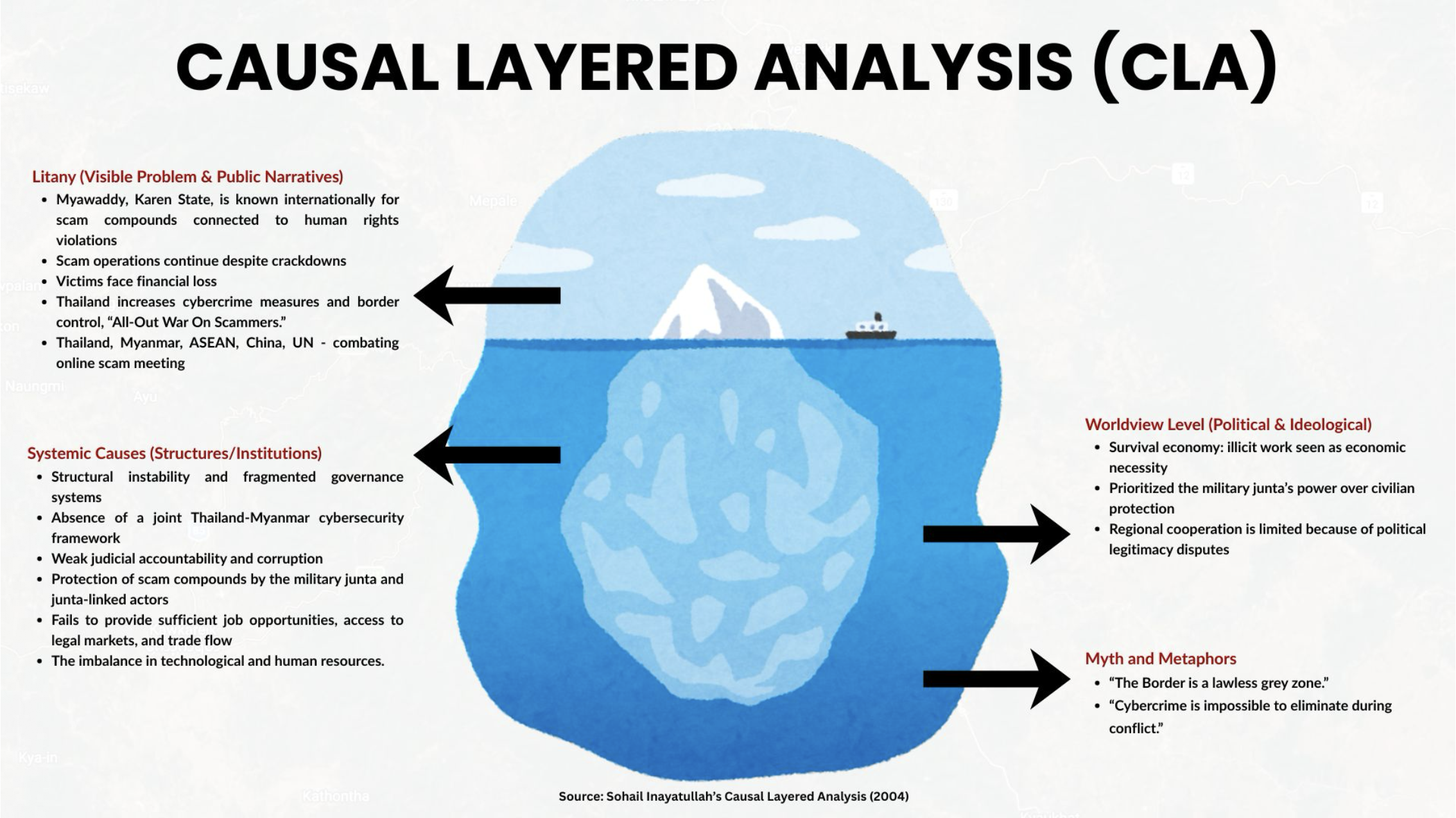
Figure (1) Classifying the Persistence of Online Scams at the Thai-Myanmar Border by Using the CLA Framework
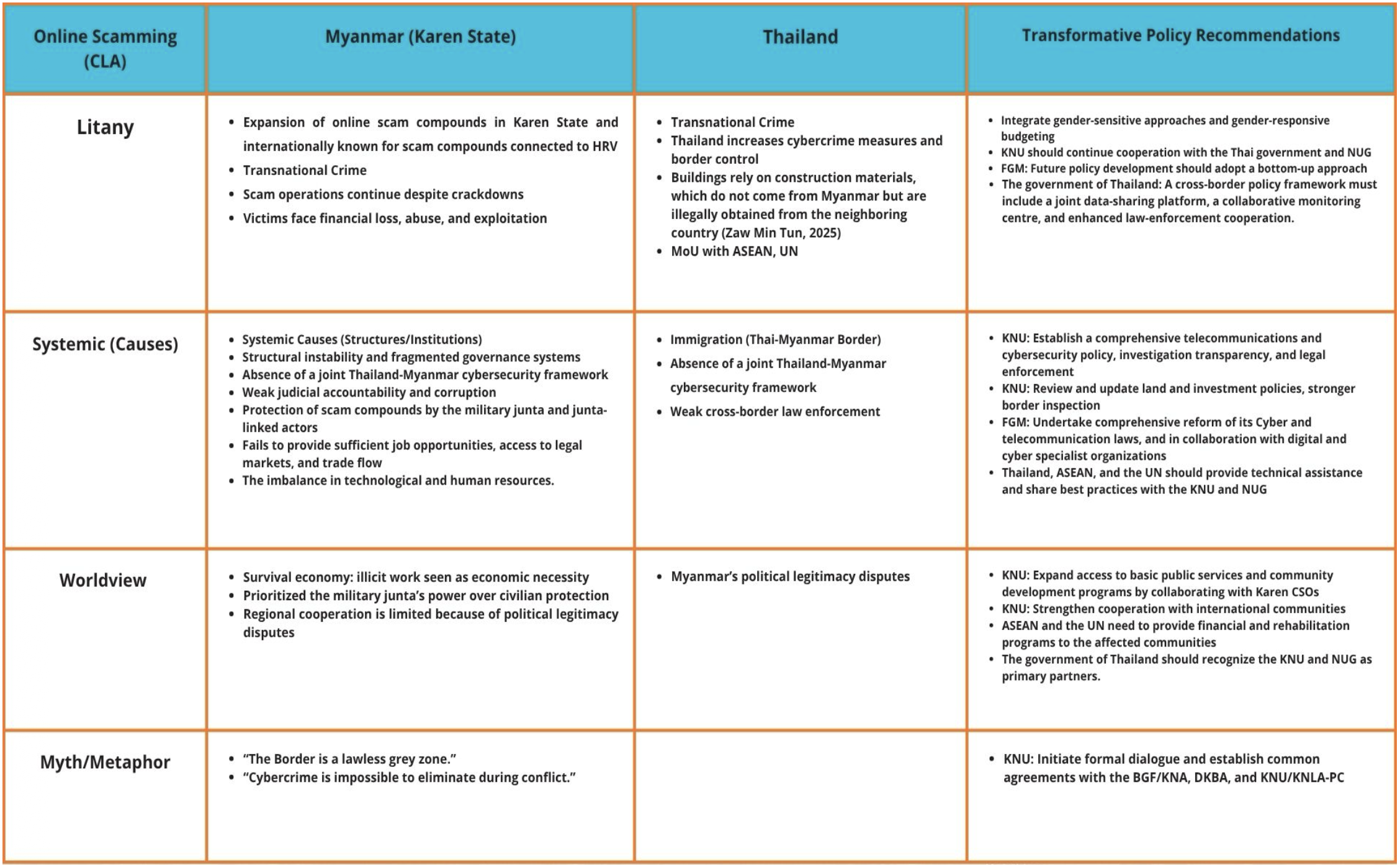
Figure (2) Transformative Policy Recommendation for Each CLA Level
References
- Bradley, Gar, & Vox. (2024, January). Policing mobile money – (K4DM) initiative. K4DM.
https://k4dm.ca/wp-content/uploads/2024/04/K4DM-MDR-02-Policing-Mobile-Money.pdf - Global Anti-Scam Alliance. (2025, August 5). State of scams in Thailand Report – 2025 | Global Anti-Scam Alliance. GASA.
https://gasa.org/knowledge-base/reports/state-of-scams-in-thailand-report-2025 - Inside Shwe Kokko: Exclusive interview with Karen BGF chief on scam crackdown. Nation Thailand. (2025, March 3).
https://www.nationthailand.com/news/policy/40046962 - Kyaw Myo Min. (2025, December 14). [Myanmar-language title]. Y & S Entertainment.
https://www.youtube.com/watch?v=QGA4jnC_0hU - Karen Peace Support Network. (2026, May 1). Burma Military’s Indiscriminate Attacks in Kawthoolei: October 2025 – March 2026. Karen Peace Support Network.
https://www.karenpeace.org/report/burma-militarys-indiscirminate-attacks-in-kawthoolei-october-2025-march-2026/ - LIBOTHAI – Law Firm. (2025, July 19). Protecting victims of online scams in Thailand: Legal rights and remedies for foreign residents (part 1/3). LIBOTHAI.
- Mishra, V. (2026, February 20). UN report exposes torture, rape in Southeast Asia’s multi-billion-dollar scam centres. UN News.
https://news.un.org/en/story/2026/02/1167012 - Miraglia, P., Ochoa, R., & Briscoe, I. (2012, October). Transnational organized crime and fragile states (EN). OECD.
- Myanmar digital coup quarterly: May 2024 to July 2024. Myanmar Internet Project. (2025, June 26).
- New Cybercrime Laws in Thailand: What foreigners need to know | Thailand Law Library. Thailand Law Library. (n.d.).
- Press, A. (2026, January 8). Why Southeast Asia’s Online Scam Industry Is So Hard to Shut Down. PBS.
- Rosvadoski-da-Silva, P., Corrêa Gomes, R., & Pinheiro Deboçã, L. (2021, July 1). Theoretical approaches to the fragility of states: Proposal for a comprehensive model from political legitimacy in statehood construct. Redalyc.
- Rotberg, R. I. (Ed.). (2004). When states fail: Causes and consequences. Gulf Research Center.
- Rogers, S. (2024, November 7). International scammers steal over $1 trillion in 12 months in global state of Scams Report 2024. Global Anti-Scam Alliance.
- Scam warlord Saw Chit Thu’s ties to the military regime return to normal. (2026, May 4). The Irrawaddy – English Edition.
- Sriyai, S. (2025, August 19). 2025/60 “Borderland Scam Centres and cyber threats: Policy considerations for Thailand” by Surachanee “Hammerli” Sriyai. ISEAS YUSOF ISHAK Institute.
- Tabara, H., George, P., Mon, S., Pandya, P., Ajara, S., & Buenaventura, T. (2026, June 5). Asia-Pacific Overview: June 2026. ACLED.
- Transnational Organized Crime – The Globalized Illegal Economy. United Nations Office on Drugs and Crime. (n.d.).
- Transnational crime in Southeast Asia: A growing threat to global peace and Security. United States Institute of Peace. (2024, May).
- The Karen Border Guard Force/Karen National Army Criminal Business Network Exposed. Justice For Myanmar. (2024, May 22).
- Thailand seizes thb24bn as scam and nominee crackdown widens. Thailand Anti-Human Trafficking Actions. (2026, June 22).
- United Thailand against scammers: A National War on Cybercrime. สำนักงานการค้าและเศรษฐกิจไทย ไทเป. (2025, December 19).
- Who Powered The Expansion of Cyber Scams in Myawaddy? Justice for Myanmar. (2025, March 4).
- Zabyelina, Y. (n.d.). Transnational organized crime in international relations.
- Zaw, H. H. (2025, February 11). Karen Border Guard Force continues to deny involvement in online scam gangs near Myawaddy. Mizzima.
Download full article: Click