
Reframing Solid Waste Management through Community Narratives: Moving Beyond the Story of Citizen Negligence

On 19 September 2026 by SPP
Author: Dhanicca Amor M. Domingo
Advisor: Pobsook Chamchong
SUMMARY
In the Philippines, decision-making is usually held by those who occupy positions of power – the technocratic, bureaucratic, and political elites. As a result, policies often emerge detached from the lived realities of the very communities who must live with their consequences. How a problem is defined determines who is blamed and what solutions are considered legitimate. In highly contested issues like solid waste management, this early framing is decisive.
This exclusion is glaring in the solid waste management problem of San Pablo City, Laguna. Prevailing policy responses continue to rely on behavior-focused, punitive approaches that frame households as the primary culprits – communities that are pasaway (disobedient), unwilling to segregate, and therefore, responsible for the system’s breakdown. This dominant narrative has persisted across two decades of policy issuances and repeated campaigns, without producing substantive results.
To challenge this framing, a community storytelling space called Kapehan was piloted in Barangay Sta. Monica. The counter-narratives that emerged reveal a different picture: households are trying to comply, but system failures – unpredictable collection schedules, a lone truck that frequently breaks down, puroks that are never reached, and unclear communication – make compliance nearly impossible. What institutions have labeled negligence is, in reality, a community quietly absorbing the consequences of a system that has never consistently worked.
From these narratives, recommendations are outlined at two levels: immediate community level interventions including composting support, decentralized drop-off points, and stronger communication systems; and medium- to long-term system reforms including fair wages for collectors, increased collection frequency, breakdown contingency plans, and mandating private subdivisions to manage their own waste. These recommendations do not ask communities to change. They ask institutions to fix the system that communities have been compensating for on their own, without acknowledgment, for years.
PERSISTENT SOLID WASTE MISMANAGEMENT IN AN ECOLOGICALLY VULNERABLE CITY
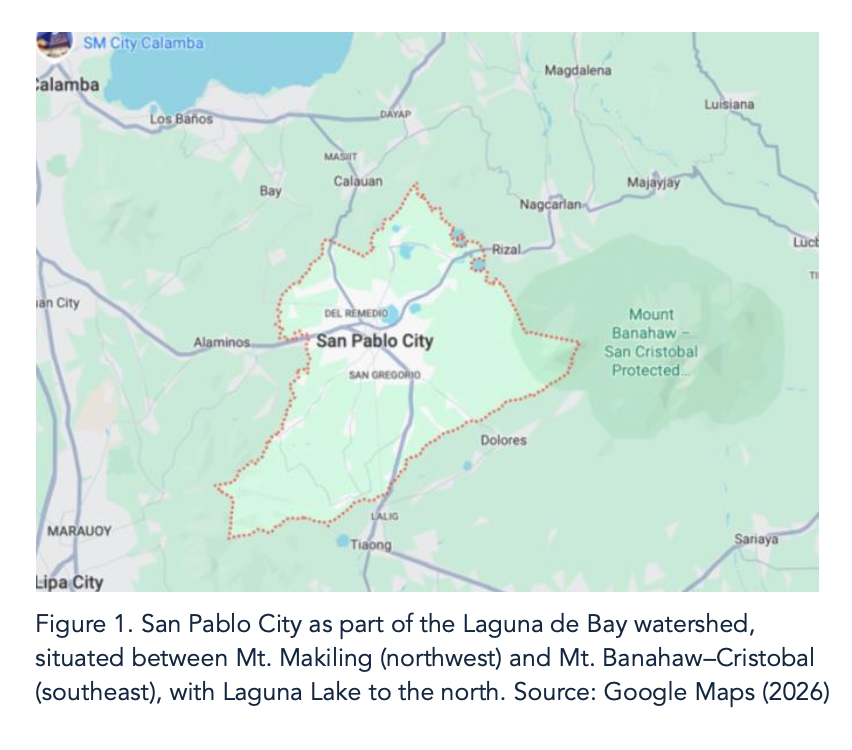
In developing countries, solid waste and its disposal is an enduring problem. The Philippines alone generates an estimated 2.7 million tons of plastic waste annually, and mismanagement of waste becomes especially damaging given the country’s already vulnerable ecosystems (Climate Change Commission, 2024). Even with the enactment of Republic Act No. 9003, or the Ecological Solid Waste Management Act of 2000 (RA 9003, 2000), the Department of Environment and Natural Resources (DENR) has noted that implementation gaps remain widespread, attributing persistent failures to inadequate waste segregation and management at the local level (Philippine News Agency, 2022).
San Pablo City in the Province of Laguna is one such local government unit facing a long-standing solid waste challenge (Manila Bay Regional Task Group, 2026). Nestled between the Mount Makiling Forest Reserve and the Mounts Banahaw – San Cristobal Protected Landscape, and widely known as the City of Seven Lakes (San Pablo City Government, 2025), San Pablo sits within the larger Laguna de Bay watershed (Laguna Lake Development Authority, n.d.), making its waste management practices environmentally consequential. Mismanaged waste does not remain local. It affects the broader watershed region.
Within the city, these challenges are most visible at the barangay level. Barangay Sta. Monica, home to an estimated 11,000 residents as of 2025 (San Pablo City Government, 2025) and generating nearly five tons of waste daily (San Pablo City Government, n.d.), is situated directly beside a river system that drains into the broader watershed.
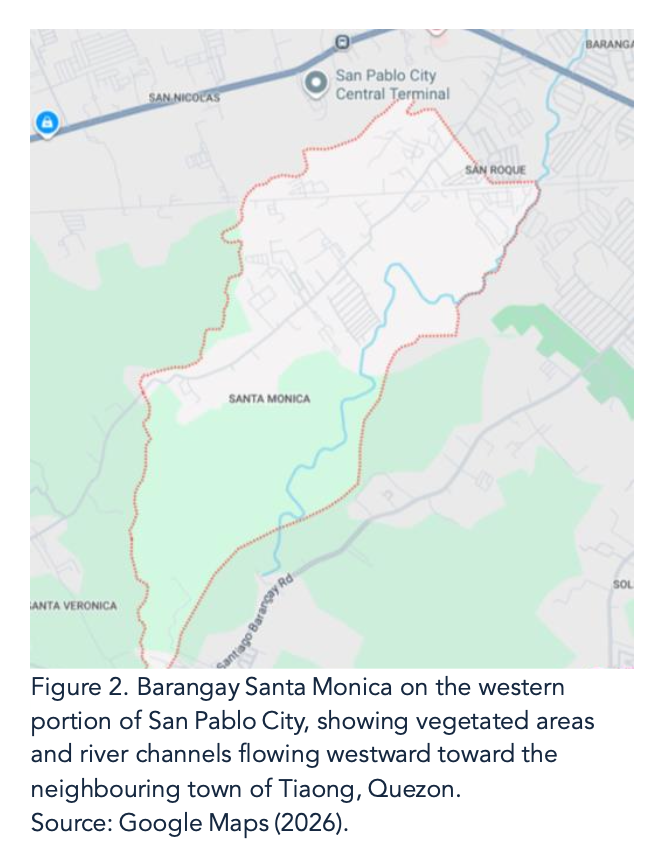
Waste build-up here carries real risks: contaminated waterways, leachate, and downstream consequences for neighbouring communities. While no formal soil or water quality testing has been conducted yet, the barangay’s ecological position already offers fruitful insight into how mismanaged waste intersects with environmental vulnerability.
THE DOMINANT NARRATIVE IN SOLID WASTE MANAGEMENT
Across two decades of policy issuances and interviews with officials and other system actors, a consistent dominant narrative emerges about the solid waste problem in San Pablo City and Barangay Sta. Monica. The problem persists because citizens are undisciplined, do not segregate, and continue improper disposal practices despite repeated policies, announcements, and reminders.
Households are framed as the main cause of waste build-up.
The city’s first documented solid waste ordinance in 2003 explicitly identified unsystematic waste disposal by households as the root cause of waste accumulation and environmental pollution (Sangguniang Panglungsod, City of San Pablo, 2003). Subsequent ordinances in 2008, 2009, and as recently as March 2026 (Sangguniang Panglungsod, City of San Pablo, 2008, 2009; Office of the City Mayor, 2026) reinforce this framing – constructing a problem definition centered on citizen negligence that has not changed in over two decades.
Compliance and discipline are positioned as the primary solutions.
Policy issuances outline household responsibilities – segregation at source, use of approved containers, proper placement along collection routes. These policies also list the prohibitions, from littering, mixing waste, open burning, and open pit dumping, paired with penalties from Php 300 to Php 1,000 with community service. The logic presented in these is straightforward: if residents followed the rules, the system would work.
Repetition of the same rules reinforces the belief that the rules are sound.
Every administration has released new solid waste policies, each largely repeating the same provisions. The Barangay Chairman of Sta. Monica confirmed that despite general assemblies, house-to-house campaigns, and verbal reminders, residents remain non-compliant (Barangay Chairman, personal communication, February 26, 2026). This pattern signals an institutional assumption that the policy design is sound, that failure lies in non-compliant citizens, and the solution is to reiterate, remind, and penalize.
Systemic issues are acknowledged but treated as secondary.
The Barangay Chairman of Sta. Monica acknowledges gaps in enforcing solid waste policies, yet also attributes the problem to residents’ persistent burning, open pit dumping, and their being used to mixed disposal. He maintains that residents continue these practices despite repeated announcements, even as he admits that enforcement remains weak (Barangay Chairman, personal communication, February 26, 2026).
Punitive and exclusionary measures are considered legitimate responses.
Rather than imposing the monetary penalties, the Barangay Chairman proposes suspending waste collection for one month for non-segregating households (Barangay Chairman, personal communication, February 26, 2026) – the logical conclusion of a narrative that positions citizens as the problem, making service withdrawal appear as a justified corrective measure.
CREATING SPACE FOR NEW NARRATIVES: THE KAPEHAN AS A TURNING POINT
For more than two decades, the city has been implementing policies grounded in the dominant narrative of citizen negligence. Contradictions and implementation gaps are set aside, and unsurprisingly, this framing leads to punitive and exclusionary measures focused on correcting community behaviour, without producing substantive results.
This raises a critical question: if policies have not been effective, why continue focusing on the same explanation? This persistent gap between policy intent and lived reality opens space for rethinking a basic assumption in policymaking. It invites us to consider what citizens know from lived experience – what they navigate daily, what they have adapted to, and what they understand about the problem that formal policy processes have not captured.
Policy knowledge is intrinsically plural. While technical and political expertise matters, so do the stories of those who live with the consequences of policies and problems every day. These stories offer insights often invisible in formal decision-making arenas, and provide a basis for reimagining a way of doing policy that begins by including communities where problems are framed, not only when solutions are already predetermined.
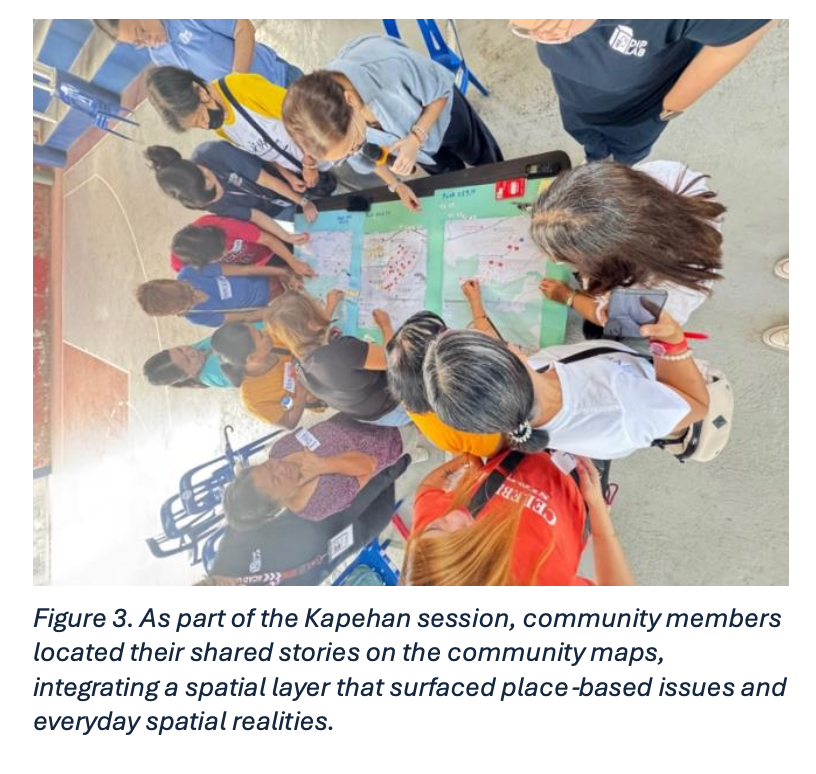 In a policy environment where non-compliance is penalized and residents are positioned as the problem, formal channels offer little room for communities to narrate their experience honestly. It is from this recognition that the Kapehan was designed – a space intentionally free from institutional interference, where residents could speak without fear of penalty, correction, or judgment. Inspired by the informality of coffeehouse conversations, the Kapehan enabled grounded, everyday conversations about solid waste. Guided by a facilitator rather than an authority figure, it surfaced stories that would otherwise remain unheard and unconsidered in formal policy processes.
Through its pilot in Barangay Sta. Monica, counter-narratives emerged – stories that challenge the dominant framing and reveal a very different understanding of the solid waste problem.
THE COUNTER-NARRATIVES IN SOLID WASTE MANAGEMENT
The stories in the Kapehan reveal interconnected counter-narratives that directly challenge the dominant institutional framing of “citizen negligence.” Rather than depicting households as unwilling to comply, the narratives show a community trying to follow the rules, but repeatedly undermined by a system that does not function as designed. These counter-narratives converge into three major storylines – pointing to system failure, the household burden it creates, and the community agency that emerges in response.
We want to comply, but the system makes compliance impossible.
Residents consistently describe efforts to segregate, store, and prepare waste properly – but these efforts collapse under system delays, inconsistencies, and communication failures. The barangay has a lone garbage truck that cannot service the entire barangay, and frequently breaks down, collapsing the whole collection system. Collection that is supposed to be daily stretches for weeks, sometimes a month. When collection finally resumes, residents try to rid themselves of all stored waste which are already attracting flies. Because of this, segregated garbage ends up mixed again in the trucks. Announcements are last-minute, unclear, and inconsistent, leaving residents unsure of when to bring waste out. The system undoes compliance even when residents do everything right. The “negligence” painted by institutions is not defiance, but resignation, born from the repeated experience of doing the right thing only to have the system fail. And the cost of that failure does not stay with the system. It is transferred entirely onto households.
We carry the burden of system failure.
Households bear the practical, financial, and emotional costs of a system that does not work. Residents freeze fish gills and gonads to prevent rot while waiting for collection – an extreme coping strategy that shows how far they go to comply. Others double-bag waste, adding to household expenses, or use rice sacks to protect garbage from roaming animals. Open pit dumping, faulted as a policy violation, was born out of necessity when delays stretch for weeks. Burning happens only when fallen leaves, excluded from collection, accumulate beyond what can be managed. Community members also noted that collectors themselves are poorly compensated, revealing another layer of conditions shaping the system’s unreliability. In this context, practices are not acts of negligence but coping strategies – burdens absorbed by residents in response to system breakdown. The material cost is compounded by an emotional one: frustration, demotivation, and a quiet resignation that things will not change. And yet, despite this weight, residents do not simply stop. They adapt. They problem-solve. They look out for one another.
We improvise solutions because the system leaves us no choice.
Residents are not passive. They feel embarrassed when waste piles up outside their houses – and that embarrassment is evidence of care, not indifference. But what is most striking is that their resourcefulness is not only individual – it is collective. Residents coordinate with neighbours when trucks are heard approaching, forming informal alert systems so no households miss collection. They give recyclables to waste pickers, constructing an informal recycling economy. They even look after the collectors themselves. Taken together, these improvisations reveal not negligence but ingenuity – a community that has built, largely on its own, a parallel system of waste management in the space left by a formal system that has not consistently arrived.
RECOMMENDATIONS GROUNDED IN COMMUNITY NARRATIVES
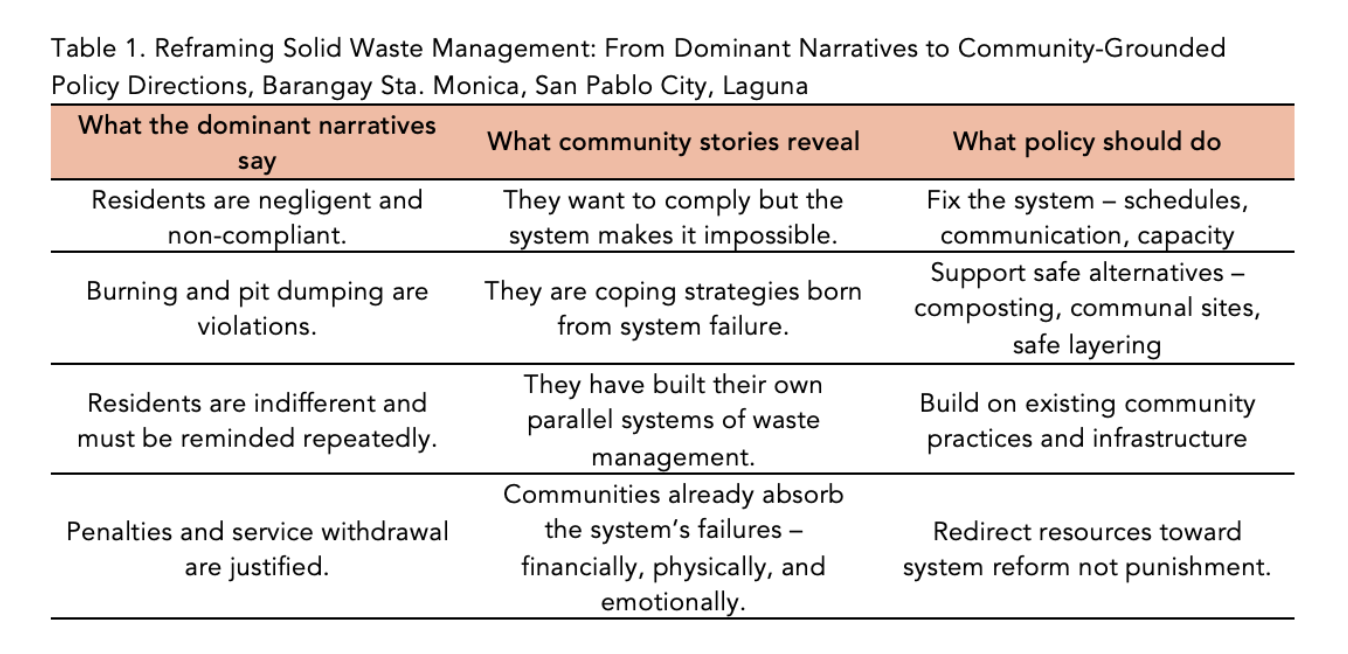
These counter-narratives reveal that the dominant narrative is both incomplete and inaccurate. Delays, inconsistent schedules, unclear communication, and capacity bottlenecks create conditions where compliance becomes impossible, and where communities are left to absorb the consequences of a system that was never fully designed to reach them.
Recommendations focus on two levels: supporting households in the immediate term while the system is being repaired and reforming the system so that the burden no longer falls on communities alone.
Short-Term, Community Level Interventions
• Safe household coping strategies should be supported, not vilified.
Residents are already managing waste as best as then can with what is available. Policy should work with these practices, not against them – providing training on basic compositing to manage organic waste, which constitutes the bulk of the barangay’s waste streams; establishing communal composting sites linked to barangay gardens; and teaching safe layering and covering techniques for makeshift pits to reduce odour, pests, and leachate while collection delays persist. Burning should be acknowledged as a practice born from necessity, requiring viable alternatives, not penalties.
• Decentralized waste drop-off points should be established.
Temporary Materials Recovery Facilities (MRFs) or drop-off stations should be set up in strategic puroks, especially in areas trucks cannot consistently reach. This is already included in existing city policy issuances. What is needed is not new legislation but the institutional will to implement what has already been prescribed.
• Communication must be clearer, more consistent, and more accessible.
Announcements through roving patrol cars are rarely heard in interior puroks. Multi-channel communication – the barangay Facebook group, text blasts, purok leaders, and physical notice boards – should replace or supplement the current uneven system. Fixed, published, per-purok collection schedules should be communicated in advance. When the system fails or is delayed, communities deserve an explanation – not silence.
Medium- to Long-Term, System-Level Reforms
• Define institutional responsibilities alongside household responsibilities.
Two decades of ordinances have prescribed what households must do. None have defined what the system is obligated to provide in return or established consequences when it fails. A revised policy framework should explicitly state the system’s obligations – collection frequency, contingency procedures for breakdowns, communication standards, and accessible collection points for underserved areas.
• Collection capacity and reliability must be strengthened.
Garbage collectors should be paid the minimum wage. Underpaid collectors affect morale, reliability, and retention, feeding directly into system breakdowns. Organic waste collection should be more frequent given that more than half of the waste stream is organic and time sensitive. Contingency plans for truck breakdowns must be established, including barangay-to-barangay mutual aid arrangements. This shortage is not unique to Sta.Monica – a city-level capacity audit across all 82 barangays is recommended to quantify the gap and justify additional infrastructure investment.
• Redistribute waste management responsibility equitably across generators.
Private gated communities and commercial establishments should be required to establish their own waste management arrangements – contracting private haulers or establishing their own MRFs. This would free public collection capacity for the residential communities currently least served. Communities with fewer resources should not be competing for the same overstretched infrastructure as private developments with the capacity to self-manage.
CONCLUSION: BUILDING POLICIES THAT SPEAK WITH COMMUNITY REALITIES
The Kapehan demonstrated that one cannot design a system while ignoring the conditions required for it to work. Community narratives offer insights that formal policy processes rarely surface on their own. In the case of solid waste management in Barangay Sta. Monica, and ultimately in San Pablo City, policy should be redesigned so that community realities, not institutional assumptions, shape how the problem is defined and addressed. When communities are given the space to speak, they do not simply complain. They diagnose. They propose. They already know what needs to change. The work of policy is to listen.
REFERENCES
[1] Climate Change Commission. (2024). Ridge to reef: The fight against mismanaged waste. https://climate.gov.ph/news/923
[2] Google. (2026). Santa Monica, San Pablo City, Laguna, Philippines [Map]. Google Maps. https://www.google.com/maps/place/Santa+Monica,+San+Pablo+City,+Laguna,+Philippines/@14.0524193,121.2982731,14z/data=!4m6!3m5!1s0x33bd42db9ecf0fd3:0x3e576b226d24b6d0!8m2!3d14.0527796!4d121.2983977!16s%2Fg%2F11bc8yw70h!5m1!1e4?entry=ttu&g_ep=EgoyMDI2MDUyNi4wIKXMDSoASAFQAw%3D%3D
[3] Google. (2026). San Pablo City, Laguna, Philippines [Map]. Google Maps.
[4] Laguna Lake Development Authority. (n.d.). Laguna de Bay. https://llda.gov.ph/laguna-de-bay/.
[5] Manila Bay Regional Task Group. (2026). 2024 local government units’ compliance assessment [Unpublished internal document; excerpt provided to the author].
[6] Office of the City Mayor – San Pablo. (2026). Strengthening the implementation and enforcement of solid waste management programs in accordance with Republic Act No. 9003 and City Ordinance No. 2003-15 (Executive Order No. 023) [Unpublished executive order].
[7] Philippine News Agency. (2022). Solid waste segregation remains major challenge in PH: DENR chief. https://www.pna.gov.ph/articles/1175460
[8] Republic Act No. 9003. (2000). An act providing for an Ecological Solid Waste Management Program, creating the necessary institutional mechanisms and incentives, declaring certain acts prohibited and providing penalties, appropriating funds therefor, and for other purposes. Official Gazette of the Republic of the Philippines. https://www.officialgazette.gov.ph/2001/01/26/republic-act-no-9003/
[9] Sangguniang Panglungsod – City of San Pablo. (2003). An ordinance approving and adopting the proposed generic ordinance on solid waste management of the City of San Pablo (Ordinance No. 2003-15) [Unpublished city ordinance].
[10] Sangguniang Panglungsod – City of San Pablo. (2008). An ordinance further amending the Comprehensive Solid Waste Management Ordinance of the City of San Pablo, duly approved, and adopted under Ordinance No. 2003-15 dated July 17, 2003 (Ordinance No. 2008-06) [Unpublished city ordinance].
[11] Sangguniang Panglungsod – City of San Pablo. (2009). An ordinance prohibiting the use of plastic bags on dry goods, prohibiting the use of styrofoams and other plastic disposable containers in restaurants and food chains, and regulating their utilization on wet goods and regulating their sale in the City of San Pablo and prescribing penalties thereof (Ordinance No. 2009-14) [Unpublished city ordinance].
[12] San Pablo City Government. (2025). The history of San Pablo. https://www.sanpablocity.gov.ph/about-us/history
[13] San Pablo City Government. (2025). San Pablo City barangays population 2025 [Unpublished internal document].
[14] San Pablo City Government. (n.d.). Waste characteristics [Unpublished internal document].
A note on the Kapehan: The Kapehan session documented in this brief was facilitated by the Development Innovations and Policy Laboratory (DIP Lab) as part of the first phase of a broader policy prototyping process designed by the author.