
SWOT Analysis of the Municipal Solid Waste Management System in Yangon, Myanmar

Author: Eaint Mo Co
Advisor: Thida Chaiyapa
Executive Summary
Yangon faces significant challenges in managing municipal solid waste due to rapid urbanization, low public awareness, limited institutional capacity, and heavy reliance on open dumping. These issues have led to environmental degradation, public health risks, and inefficiencies in waste management. This policy brief uses a SWOT analysis based on secondary data to identify key problems, including inadequate enforcement of waste regulations, limited citizen engagement, and an inefficient waste collection practice. It offers practical, locally relevant policy recommendations to promote a more sustainable waste management system. Addressing these challenges is essential to guide Yangon toward a cleaner, more inclusive, and sustainable urban future.
Problem Statement
Yangon, Myanmar’s largest economic hub, generates approximately 2,500 to 2,700 tones of municipal solid waste daily across its 33 townships. The Yangon City Development Committee (YCDC) is responsible for MSW management, and the city faces severe environmental degradation and public health risks due to poor waste practices and weak enforcement (Premakumara et al., 2017). Open dumping remains the dominant disposal method (Mo, 2021), contributing to groundwater contamination, toxic gas emissions, and serious incidents like the Htein Bin landfill fire, which affected over 148,000 residents (United Nations Myanmar, 2021). According to YCDC, only 5% of waste is recycled, 2.4% is converted to energy, and the rest is sent to inadequately managed disposal sites. On top of that, several backstreets in Yangon are still full of waste, which resulted from illegal dumping (Min, 2023). Low public awareness outdated financial mechanisms, and inefficient waste collection seriously impact the effectiveness of the MSW system. Without effective intervention, Yangon’s MSW management system will continue to impact public health and worsen environmental conditions.
Methodology
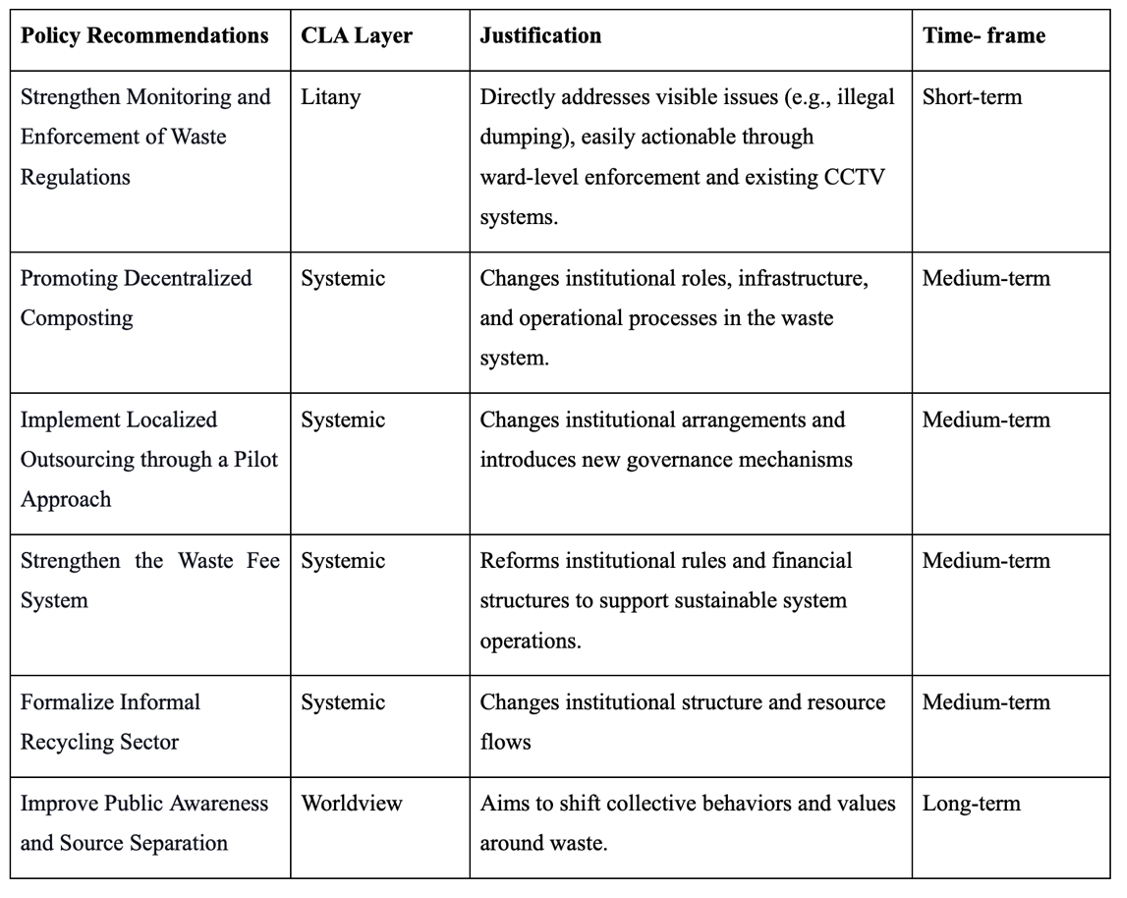
This study adopts a qualitative, secondary data-based research design focused on Yangon’s municipal solid waste (MSW) system. Data were drawn from official government reports, academic articles, and NGO publications and collected through targeted searches of official websites and online databases. The collected data were organized thematically to identify patterns and recurring issues within the literature and reports. A SWOT framework is the primary analytical tool, structuring key insights into internal (strengths and weaknesses) and external (opportunities and threats) factors. Based on the SWOT findings, a set of context-specific policy recommendations was developed.These recommendations were mapped to the Causal Layered Analysis (CLA) framework according to the depth of change they target, which helps stakeholders understand the scope and timeframe of each policy action.
Key findings and Discussion
SWOT Matrix of Yangon’s Municipal Solid Waste Management System
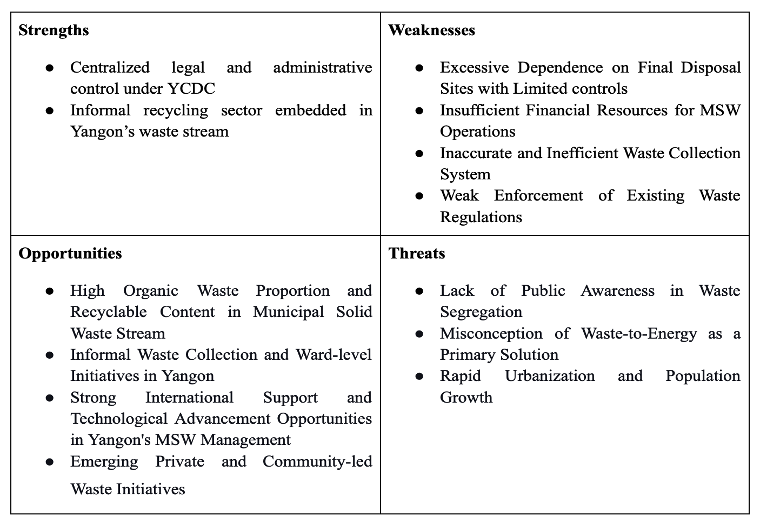
Strengths (Internal Factors)
- Centralized Legal and Administrative Control under YCDC
YCDC is financially self-reliant, raising revenue through business licenses and property taxes. It is also the sole public institution with legal authority over municipal solid waste services in Yangon (Jeske et al., 2021). This centralized system ensures coordinated service delivery, consistent policy enforcement, and streamlined engagement with external stakeholders. It also enhances accountability and reduces administrative overlap, enabling YCDC to scale services, set city-wide standards, and implement reforms efficiently as the city grows.
- Informal Recycling Sector Embedded in Yangon’s Waste Stream
Yangon plays a central role in Myanmar’s decentralized recycling economy, which is run by an extensive informal network of scavengers, waste collectors, and waste dealers. The sample survey conducted in Yangon shows that approximately 86 tonnes of recyclable materials are recovered daily, of which 57% accounted for glass, 28 % accounted for paper and cardboard, 14% accounted for plastics and tin, and others 1% (UNEP-IETC & IGES-CCET, 2016). Although the sector remains largely unsupported by YCDC, it plays a crucial role in diverting waste from disposal sites. Therefore, Yangon’s existing recycling network provides a solid foundation for developing a more coordinated and formalized materials recovery system.
Weaknesses (Internal Factors)
- Excessive Dependence on Final Disposal Sites with Limited Controls
Yangon’s current disposal method relies too much on final disposal sites, with over 90% of collected waste directed to six final disposal sites, apart from 2.4 % to a waste-to-energy plant and 5% for recycling, according to YCDC. Almost all the final disposal sites are mostly open dumping. In these sites, waste is sorted manually using tools such as rakes, and bulldozers are used to send unsorted waste inside the dump site (Premakumara et al., 2017). This practice creates a lot of waste in disposal sites and causes landfill fires. Too much dependence on open dumps causes serious environmental pollution and disasters like landfill fires.
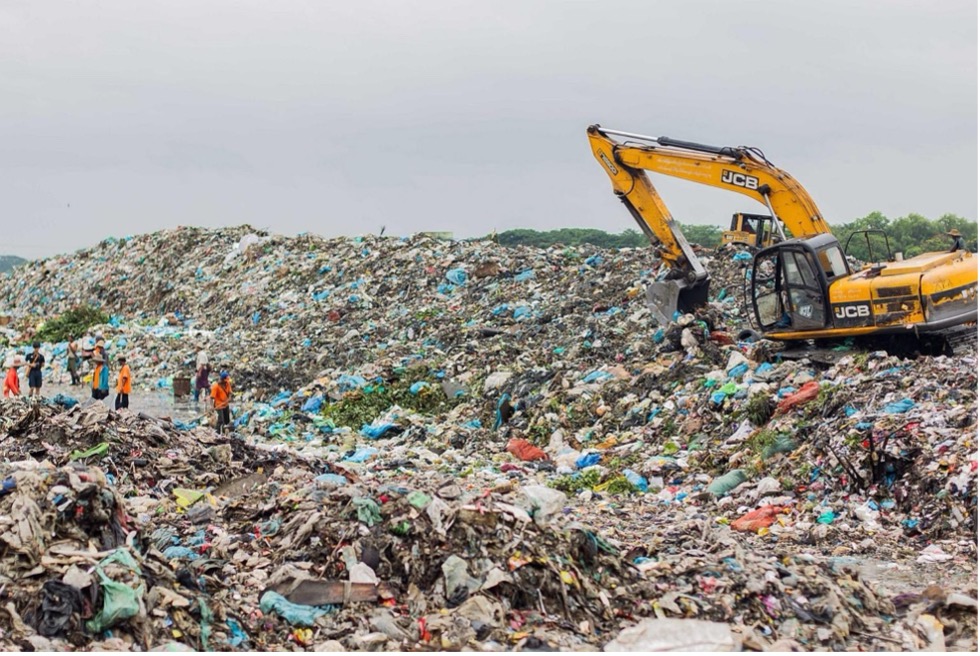
Photo 1. Htein Bin waste disposal site in Yangon City, Myanmar.
Source: Photo by Daniel Neo (2016), The Straits Times.
- Insufficient Financial Resources for MSW Operations
To collect waste management fees, YCDC divided 33 townships into three groups: residents pay 20 kyat/day in the Central Business District, 15 kyat/day in suburban areas, and 10 kyat/day in satellite zones (Han, 2019). This fee is collected every three months. However, the waste management fee is too low to cover the real cost of MSW management. The collection fees can cover only one third of the total cost and only 480,000 households out of one million households pay the waste management fees (Lynn, 2018). This weak financial structure limits YCDC’s ability to invest in infrastructure, adopt modern waste technologies, and enhance service quality.
- Inaccurate and Inefficient Waste Collection System
In Yangon, waste collection relies on door-to-door, block, and container methods. Although YCDC claims to provide waste collection services to over 90% of the city, estimates show that only about 45% of the total MSW generated reaches final disposal sites (Rijksdienst voor Ondernemend Nederland, 2017). This overestimation is because YCDC only measured the number of wards served rather than the number of households receiving regular collection. Inconsistent collection services led the public to depend on informal collectors who sometimes dispose of waste in open plots or water sources, creating a burden for YCDC (Han, 2019). This also causes illegal dumping. These situations can lead to poor planning, budget misallocation, and environmental degradation.
- Weak Enforcement of Existing Waste Regulations
Under the Yangon City Development Committee Acts of 2018, the Pollution Control and Cleansing Department (PCCD) of YCDC imposes waste management policies, implements regulations, and enforces penalties (Han, 2019). Nevertheless, the actual enforcement is insufficient to change public behavior. This challenge is compounded by the absence of monitoring and evaluation mechanisms at both the national and regional levels to implement MSW standards and reforms (Jeske et al., 2021). Consequently, Yangon citizens do not follow regulations. This enforcement gap reduces the impact of well-designed policies and contributes to overall system underperformance.
Opportunities (External Factors)
- High Organic Waste Proportion and Recyclable Content in Municipal Solid Waste Stream
According to YCDC, the MSW generation rate is between 2500 to 2700 tons. Food waste makes up 44% of these wastes, and 31% is recyclable materials such as plastics, paper, and metal (Tun & Juchelková, 2018). Yangon’s high proportion of organic and recyclable waste presents significant opportunities to transform the city’s waste management system. The high proportion of organic waste is ideal for composting initiatives, which can reduce waste going to final disposal sites, and there is a potential for expanding recycling programs since 31 % of MSW is recyclable, which can create economic opportunities and reduce environmental harm.
- Informal Waste Collection and Ward-level Initiatives in Yangon
In Yangon, an informal form of ward-level outsourcing has emerged, where contractors collect waste door-to-door and hand it over to YCDC at the collection point to transport it to final disposal sites (The Asia Foundation, 2020). YCDC sometimes resists collaborating with these informal collectors because of the lack of licenses, unhygienic conditions, and usage of child laborers (Jeske et al., 2021). The informal waste collectors and grassroots initiatives fill the gaps in Yangon’s MSW management system, especially in underserved areas. Their presence improves collection coverage and reduces waste going to final disposal sites.
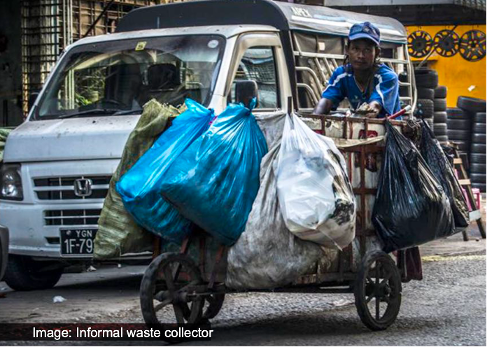
Photo 2. Informal waste collector.
Photo source: Jeske et al. (2020).
- Strong International Support and Technological Advancement Opportunities in Yangon’s MSW Management
Yangon gets significant financial and technical assistance from international organizations to improve its MSW management system. For example, Japan promoted waste-to-energy technologies and co-invested in constructing a pilot waste-to-energy plant in Yangon. International organizations like the Asian Development Bank (ADB) supported the development of Yangon’s solid waste management system through funding, technical assistance, and pilot projects (Thien et al., 2020). This external support can strengthen Yangon’s MSW management capacity to develop efficient waste management infrastructure, addressing current technical and resource limitations.
- Emerging Private and Community-led Waste Initiatives
Yangon is seeing the emergence of promising social enterprises and community initiatives tackling urban waste challenges. Bokashi Myanmar and RecyGlo are leading private-sector efforts in composting and recycling (Jeske et al., 2021). Likewise, small-scale enterprises like the Chu Chu store in Dala township collect clean plastic waste and upcycle it into consumer products like handbags. Doh Eain’s alley garden project transforms waste-littered urban alleys into clean and socially vibrant public spaces (Hulsman, Breukelman, & Keesman, 2017). Although their scale is limited, they present a significant opportunity for authorities to collaborate with grassroots actors, strengthen the city’s recycling capacity, and expand environmental awareness across Yangon.
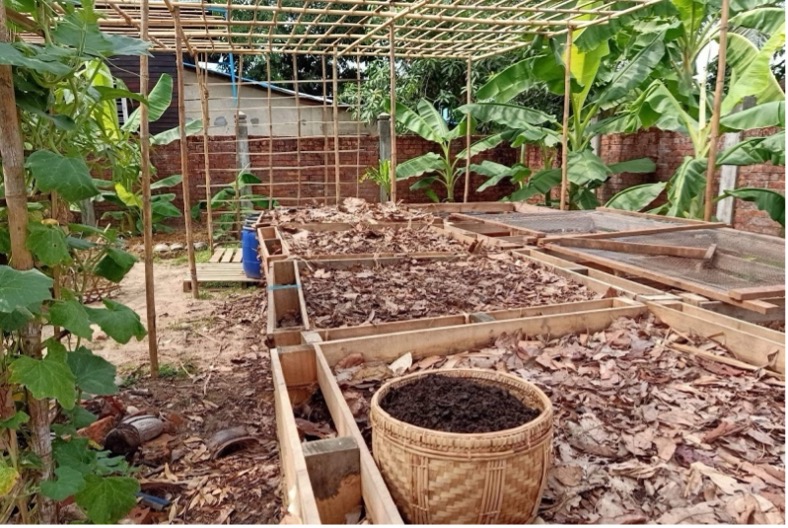
Photo 3. Bokashi Myanmar composting site.
Photo source: Bokashi Myanmar (n.d.).
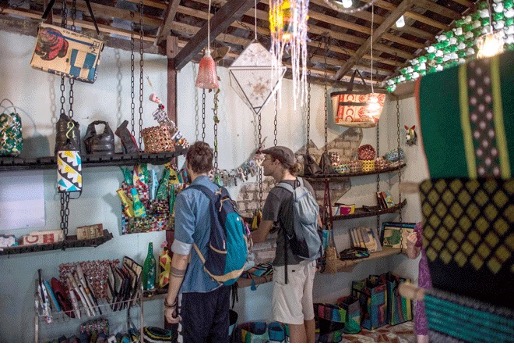
Photo 4. Chu Chu store in Yangon.
Photo source: The Borneo Post (2018).
Threats (External Factors)
- Lack of Public Awareness in Waste Segregation
YCDC is running two programs, School Awareness Programs, and Public Awareness Programs, to raise awareness in Yangon. However, according to the survey conducted by Min Nay Han (2019), 400 respondents were interviewed from Thingangyun and South-Okkalapa townships; only 25.5% of respondents have waste segregation awareness, and only 28% of respondents have an awareness level of color-coded bag segregation methods imposed by YCDC, while 21% follow the segregation method. The lack of public awareness of segregation can contaminate recyclable materials, reducing the recycling efficiency that could lead to an increased volume of waste sent to the final disposal sites.
- Misconception of Waste-to-Energy as a Primary Solution
Myanmar authorities view Waste-to-energy as a viable solution to the country’s solid waste management challenges because of the influence of international companies looking for new markets for their WtE products (Hulsman, Breukelman, & Keesman, 2017). However, due to the long monsoon season, Myanmar’s MSW composition is dominated by high-moisture organic materials, which makes incineration inefficient. On top of that, Myanmar’s electricity prices are low and might not provide enough financial return for infrastructure investment. YCDC will face serious challenges in feeding electricity into an unstable grid. Over-emphasis on WtE could divert attention and resources away from more appropriate, low-cost solutions like composting or decentralized recycling systems.
- Rapid Urbanization and Population Growth
Yangon’s growing urban population increases the volume of waste generation, creating strain on the current MSW management system. According to the UN-Habitat Myanmar Country Report (2023), Yangon has experienced rapid urbanization in recent years, with significant population growth driven by rural-to-urban migration and economic centralization. This situation led to new peri-urban settlements where formal waste collection services are often underserved. Moreover, current MSW management infrastructures are already operating at or beyond capacity. Without strategic reform of the MSW system, continued population growth could further strain the system, increase public health risks, and erode public trust in municipal services.
Policy Recommendations
1. Promoting Decentralized Composting to Manage Organic Waste and Reduce Landfill Pressure
With organic waste making up 44% of Yangon’s MSW, decentralized composting offers a low-cost, practical solution to reduce waste volume and landfill pressure. YCDC should establish ward-level composting stations and take responsibility for constructing the necessary infrastructure, such as compost bins and basic equipment, while collaborating with Bokashi Myanmar for technical support and training. Local ward committees or environmental groups can take responsibility for routine tasks such as maintaining compost piles and monitoring cleanliness. The compost can be used for urban greening and local agriculture. Yangon can reduce its dependency on landfills, encourage resource recovery, and provide the groundwork for a more robust and inclusive waste management system by composting.
2. Implement Localized Outsourcing through a Pilot Approach
YCDC should adopt a localized outsourcing model for primary waste collection by formalizing existing informal sectors. YCDC should implement pilot programs in selected wards where informal door-to-door collection is already active and widely relied upon by residents. These pilot programs should formalize informal sectors through simple contracts or licenses, assess their performance, test standardized fee structures, and define supervisory roles for ward officials. The pilot’s insights will guide the formulation of standardized contracts, identification of training requirements, and establishment of accountability systems. This approach allows YCDC to build on existing practices that can reduce its collection burden.
3. Improve Public Awareness and Source Separation at the Household Level
Current YCDC awareness activities mostly rely on traditional outreach methods and have limited impact. Therefore, YCDC should establish a social media-based public awareness campaign on Facebook and TikTok, which are widely used in Myanmar. This campaign should focus primarily on household waste segregation and important 3R practices. To encourage public participation in source segregation, a competition such as the Sort at Home Contest can be organized, where the public posts their practices on social media, and winners should be rewarded with color-coded bags or recognition awards from YCDC. Targeted behavioral nudges can foster household-level waste responsibility, improving separation and strengthening composting and recycling in Yangon.
4. Strengthen Monitoring and Enforcement of Waste Regulations
YCDC should establish a dedicated enforcement mechanism at the ward level, with trained officers responsible for regular spot checks, issuing fines, and providing on-the-ground guidance to households and businesses to strengthen monitoring and enforcement. Moreover, illegal dumping may be monitored with the help of Yangon’s current CCTV system installed in public spaces, streets, and intersections. To build public trust and accountability, enforcement results should be shared through ward offices or online platforms. Finally, a community reporting system that enables people to report violations should be implemented. For example, hotline mobile messaging or internet platforms. Consistent, visible penalties will deter violations and strengthen Yangon’s capacity to enforce waste regulations.
5. Strengthen the Waste Fee System to Improve Financial Sustainability
To strengthen the waste fee system, YCDC should gradually increase the fee rates to match actual service costs. YCDC should regulate rules that people need to show proof of waste fee payment when they apply for or renew building permits, household registrations, or business licenses. In addition, YCDC should implement basic enforcement strategies like late payment fees or reminders. By doing this, YCDC can encourage people to pay the waste fee. Enhancing the fee structure can create a waste management system that is more robust, equitable, and sustainable.
6. Formalize and Support the Informal Recycling Sector
To improve Yangon’s recycling system, YCDC should formally recognize and support informal recyclers. This includes issuing basic ID cards or permits, training on safe handling and sorting, and providing equipment like gloves and masks. YCDC should also establish drop-off points in neighbourhoods where recyclables can be sorted and sold. Moreover, YCDC should collaborate with private social enterprises such as RecyGlo and Chu Chu Store, which can help absorb materials collected by informal recyclers, scale up sustainable recycling models, and create green jobs. If YCDC integrates informal workers into a more organized system, Yangon can improve recycling rates, promote social equity, and support a circular economy.
Table 2. Policy Recommendations Organized by CLA Layers
Conclusion
The waste problem in Yangon needs to be addressed strategically, inclusively, and locally. Through a SWOT analysis, this study reveals both the internal weaknesses of the current MSW system and the potential for positive transformation. Although challenges remain, targeted actions such as promoting composting, integrating informal waste workers, and raising public awareness can create a significant impact. Yangon can advance towards a cleaner, more equitable, and sustainable urban future by following these steps.
References
[1] Bokashi Myanmar. (n.d.). Composting stack site [Photograph]. Retrieved June 20, 2025, from https://bokashimyanmar.com/how-to-use-bokashi/how-to-build-a-bokashi-compost-stack/
[2] Han, M. N. (2019). Analysis on waste management behaviour of Yangon citizens (Master’s thesis, Yangon University of Economics).
[3] Hulsman, H., Breukelman, H., & Keesman, B. (2017). Scoping mission on integrated solid waste management (ISWM) to Myanmar. Ministry of Foreign Affairs. https://www.myanmarwaterportal.com/repository/478-myanmar-waste-scoping-mission-report.html
[4] Jeske, F., Muller, P.-E., Møller, A. K., & Rothenberg, E. (2020). Digging through: An inside look at municipal waste management in Myanmar. Institute for Global Environmental Strategies; Thant Myanmar.
[5] Lynn, K. Y. (2018, June 5). More than just pollution concerns at Htein Bin dump. Frontier Myanmar. https://www.frontiermyanmar.net/en/more-than-just-pollution-concerns-at-htein-bin-dump/
[6] Min, H. S. (2023). A study on knowledge, attitude and practice towards household waste disposal: A case study in Kyauktada Township, Yangon Region (Doctoral dissertation, Yangon University of Economics, Department of Applied Economics, Master of Public Administration Programme). MERAL Portal.
[7] Mo, M. (2021). Life cycle assessment-based optimal economic for sustainable municipal solid waste management system in Yangon City, Myanmar (Master’s thesis, Sirindhorn International Institute of Technology, Thammasat University).
[8] Neo, D. (2016, January 20). No time to waste: Dealing with Yangon’s trash problem [Photograph]. The Straits Times. https://www.straitstimes.com/asia/se-asia/no-time-to-waste-dealing-with-yangons-trash-problem
[9] Premakumara, D. G., Hengesbaugh, M., Onogawa, K., & Hlaing, O. M. T. (2017). Waste management in Myanmar: Current status, key challenges, and recommendations for national and city waste management strategies.
[10] Rijksdienst voor Ondernemend Nederland. (2017, June). Scoping mission on integrated solid waste management (ISWM) to Myanmar: Report of findings. Netherlands Enterprise Agency.
[11] The Borneo Post. (2018, June 6). Myanmar enterprise tries to make trash trendy [Photograph]. https://www.theborneopost.com/2018/06/06/myanmar-enterprise-tries-to-make-trash-trendy/
[12] Thien, H. M., Maw, M., Thin, N. N., Latt, H., Onogawa, K., Gamaralalage, P. J. D., … & Hlaing, O. M. T. (2020). National
Waste Management Strategy and Master Plan for Myanmar (2018–2030).
[13] The Asia Foundation. (2020). An economic analysis of solid waste management outsourcing in Myanmar. https://asiafoundation.org/publication/an-economic-analysis-of-solid-waste-management-outsourcing-in-myanmar/
[14] Tun, M. M., & Juchelková, D. (2018). Assessment of solid waste generation and greenhouse gas emission potential in Yangon city, Myanmar. Journal of Material Cycles and Waste Management, 20(3), 1397–1408. https://doi.org/10.1007/s10163-017-0697-y
[15] UNEP-IETC, & IGES-CCET. (2016). Quick study on waste management in Myanmar: Current situation and key challenges (1st draft). UNEP-IETC & IGES-CCET.
[16] UN-Habitat. (2023). Myanmar Country Report. UN-Habitat Regional Office for Asia and the Pacific. https://fukuoka.unhabitat.org/wp-content/uploads/2023/08/13.-Myanmar-Country-Report_30-June-2023_4.pdf
[17] United Nations Myanmar. (2021). UN-Habitat’s project improving solid waste management in Yangon City. https://myanmar.un.org/en/123338-un-habitat’s-project-improving-solid-waste-management-yangon-city
Download full article: Click