
Policy Lessons from Singapore for Thailand’s Role in the Myanmar Arms Trade

Author: Haemar Ba Kyu
Advisor: Ora-orn Poocharoen
Summary
This policy brief explores how Thailand became a key financial conduit in the Myanmar military junta’s international arms trade following Singapore’s regulatory crackdown in 2023. The Myanmar junta, responsible for widespread atrocities, has procured over $1 billion USD in weapons and dual-use materials since the 2021 coup (UNHRC, 2023). The brief defines the nature of this arms trade, establishes it as a wicked policy problem, and compares Thailand’s and Singapore’s responses using Policy Network Theory. While Singapore acted quickly due to its reliance on its financial reputation, Thailand has begun to acknowledge the problem and take meaningful, if limited, steps toward reform. The brief concludes with policy recommendations to strengthen Thailand’s regulatory capacity and banking oversight.
I. Introduction
The international arms trade involves the movement of weapons, military technologies, dual-use goods, and financing across borders (SIPRI, 2025a). Dual-use goods are items, materials, or technologies that can be used for both civilian and military purposes, such as drones, navigation systems, and certain electronic components. While some transfers are legal and regulated, others enable authoritarian regimes to perpetrate atrocities with impunity (SIPRI, 2025b).
In Myanmar, following the 2021 military coup, the State Administration Council (SAC) relied on imported arms and related financial services to sustain widespread violence. These transfers, often routed through third-party jurisdictions and networks, defy simple solutions. The Myanmar case represents a wicked policy problem: multifaceted, deeply entrenched in transnational systems, and resistant to quick fixes. As reasearchers from the Stockholm International Peace Research Institute (2025b) emphasize, global arms transfers frequently involve dual-use technologies, multi-jurisdictional networks, and poor transparency practices, which significantly complicate detection, regulation, and accountability.
Loopholes in sanctions, poor enforcement, and opaque financial systems allow military-linked entities to procure critical goods and services despite international condemnation (UNHRC, 2022; Amnesty International, 2022). Fortify Rights (2022), in partnership with Yale Law School, found that Myanmar military and police forces systematically committed widespread and coordinated attacks on civilians in the aftermath of the coup, amounting to crimes against humanity. Their report traced these abuses to senior command levels, highlighting the structural impunity of military-linked institutions and the central role of state-directed violence in the junta’s governance model.
II. Background
Until 2022, Singapore served as a major hub for military-linked procurement by Myanmar. Investigations by the UN and Justice for Myanmar identified over 138 Singapore-based entities supplying dual-use goods or financial services to junta-affiliated actors. Responding swiftly to international pressure, Singapore initiated investigations, issued policy guidance, and coordinated across agencies (Justice for Myanmar, 2022). By mid-2023, arms-related transfers from Singapore dropped by more than 90% (UNHRC, 2023).
This created a vacuum—one that Thailand inadvertently filled. UN reports show that in FY2023, Thailand became the largest conduit of arms-related financial transactions linked to Myanmar, processing over $120 million, double the previous year (UNHRC, 2024). Thai-registered businesses supplied spare parts for aircraft and naval vessels, dual-use electronics, and raw materials. Financial institutions, including Bangkok Bank, Kasikornbank, Krungthai Bank, Siam Commercial Bank, and Thanachart Bank, were named as processors of these transactions (Prachatai, 2025).
In July 2024, the Parliamentary Committee on National Security, Border Affairs, National Strategy, and National Reform, chaired by Rangsiman Rome, publicly declared the use of Thai banks to facilitate arms dealing with the Myanmar junta as unacceptable and mandated the formation of the interagency task force. Rome stated, “We need to use Singapore as a model to address this issue. If our banking system has been used to facilitate arms dealing and support the Myanmar junta in killing its people, this is something the committee thinks is unacceptable”. Following this directive, bank representatives acknowledged their lack of capacity to investigate arms-related transactions and expressed willingness to cooperate with regulators and improve compliance systems (Reuters, 2024).
III. Policy Question
How can Thailand address its role in the Myanmar Arms Trade, drawing policy lessons from Singapore’s successful response?
IV. Methodology
This brief employs comparative policy analysis and Policy Network Theory to evaluate responses in Singapore and Thailand. Sources include UN Special Rapporteur reports (2022–2025), Amnesty International, Justice for Myanmar, and official statements from Singaporean and Thai regulatory bodies.
V. International Commitments and Legal Frameworks
Financial Action Task Force (FATF) Standards
Both Singapore and Thailand are members of the Financial Action Task Force (FATF), the global standard-setting body on anti-money laundering and counter-terrorism financing. FATF guidance significantly influences how states structure financial compliance systems, including measures to combat proliferation financing and detect arms-related transactions. Recent FATF recommendations emphasize the need for enhanced due diligence, sanctions screening, and interagency coordination to prevent misuse of financial institutions by authoritarian regimes (FATF, 2018).
Arms Trade Treaty (ATT) and Control Acts
They have also signed the Arms Trade Treaty (ATT) since 2014 but neither have ratified it (UN Treaty Collection, 2025). However, Singapore coordinates many of its national arms control measures in alignment with ATT principles. It maintains an advanced Strategic Goods (Control) Act, which governs exports, dual-use technologies, and transshipment under a single regulatory regime (Singapore Customs, 2021). Thailand’s Control on Weapons of Mass Destruction Related Items Act (2019), on the other hand, focuses primarily on items related to the proliferation of weapons of mass destruction (WMDs). While the Act includes provisions for controlling dual-use items, its current implementation is limited. As of May 2024, Thailand plans to enforce licensing requirements for the export and re-export of certain dual-use items, starting with heavy and nuclear equipment, to enhance compliance with international obligations (Global Compliance News, 2024).
VI. Analysis
This section applies Policy Network Theory, which highlights the interdependence and coordination among state and non-state actors in shaping policy outcomes (Klijn & Koppenjan, 2016; Sørensen , 2021). The Myanmar arms trade case presents a complex governance challenge, where policy responses depend not only on formal laws but also on how responsive and integrated policy networks are in practice.
Singapore: A Centralized and Strategic Policy Network
Singapore’s policy response was shaped by a strategic and centralized policy network, motivated by its strong reliance on financial credibility and global reputation. Once the UN Special Rapporteur released his findings in early 2023, Singapore’s network responded swiftly and decisively—demonstrating high coordination across multiple government agencies (UNHRC, 2023; Justice for Myanmar, 2022; MFA Singapore, 2023).
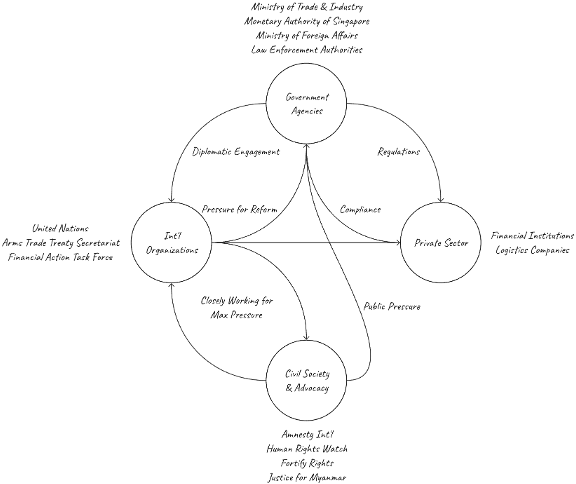
Source: Author’s understanding of Singapore’s response
Key institutions—including the Monetary Authority of Singapore (MAS), Ministry of Trade and Industry (MTI), Ministry of Foreign Affairs (MFA), and law enforcement bodies—acted cohesively. MAS directed banks to apply enhanced due diligence and tighten transaction monitoring systems. MTI and Singapore Customs coordinated enforcement of the Strategic Goods (Control) Act, revoking permits and increasing export scrutiny. The MFA issued public statements affirming Singapore’s commitment to international norms and cooperation with the UN (UNHRC, 2023; UNHRC, 2024; MFA Singapore, 2023).
The Attorney-General’s Chambers also launched investigations into potential legal breaches. Within months, the network had conducted risk reviews of implicated companies and implemented new compliance controls. By mid-2023, arms-related exports to Myanmar had declined by over 90% (UNHRC, 2023), showcasing Singapore’s ability to act preemptively and protect its strategic interests.
Singapore’s success reflects more than regulatory readiness—it reflects a deeply integrated and agile policy network, reinforced by the reputational incentives of being a global financial hub.
Thailand: Fragmented Networks, Reactive Engagement
Thailand’s policy response, by contrast, reveals a fragmented and slower-moving network, hindered by weaker interagency coordination and limited enforcement authority. Key actors—such as the Anti-Money Laundering Office (AMLO), Bank of Thailand (BOT), the Ministry of Foreign Affairs, and the Thai Bankers’ Association—operate in parallel but without clear, sustained integration.
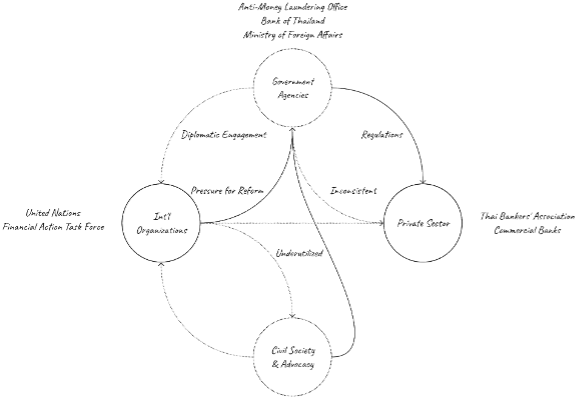
Source: Author’s understanding of Thailand’s reponse
Following the June 2024 UN report naming Thai financial institutions as facilitators of junta-linked transactions, Thailand began to mobilize. A Myanmar Arms Finance Task Force was formed in July 2024, co-led by AMLO and BOT, marking the first major step toward coordinated oversight. The task force received detailed information from the UN and initiated a review of high-risk transactions, resulting in compliance advisories by year-end (AMLO & BOT, 2024; UNHRC, 2025).
In early 2025, the task force issued draft guidance, and the Thai Bankers’ Association advised its members to strengthen due diligence procedures (TBA, 2025). While these are important first steps, civil society organizations—namely Justice For Myanmar and Fair Finance Thailand—have criticized the process for its lack of transparency and weak public accountability mechanisms (Justice for Myanmar, 2025; Prachatai, 2025).
Thailand’s Ministry of Foreign Affairs remained largely disengaged likely due to Thailand’s need to balance diplomacy, boarder stability and economic relations with Myanmar. Furthermore, the absence of a strong reputational incentive—as seen in Singapore’s financial diplomacy—meant less urgency in activating the policy network. Efforts have thus far been limited to anti-money laundering reforms, with little progress in arms export control or dual-use regulation (UNHRC, 2025).
To improve its capacity, Thailand also amended its Anti-Money Laundering Law in March 2025 to better align with FATF standards, including broader reporting obligations and enhanced enforcement mechanisms (Mahanakorn Partners, 2025). However, without a comprehensive strategic goods control framework and deeper policy coordination, these reforms remain partial and reactive.
VII.Recommendations
For the Thai Government:
- Develop a Comprehensive Arms Control Regime
- Expand the scope of control legislation to include conventional arms and dual-use technologies, building on the TCWMD Act to develop a comprehensive strategic goods control regime akin to Singapore’s model.
- Ratify the ATT to formalize Thailand’s international legal obligations and align domestic enforcement with global norms on arms transfer accountability.
- Strengthen the investigative mandate of Thai Customs and ensure it plays an active role in interdicting arms-related and dual-use shipments.
- Institutionalize and Coordinate Oversight
- Make the the Myanmar Arms Finance Task Force a permanent body.
- Coordinate policy enforcement between AMLO, BOT, MFA, Customs.
- Ensure Transparency and Public Accountability
- Mandate public reporting of dual-use trade and Myanmar-linked transactions.
- Issue a national guidance list of flagged individuals and firms based on UN, FATF, and civil society databases.
For Thai Financial Institutions:
- Strenghten Financial Oversight and Compliance Capacity
- Apply rigorous enhanced due diligence for Myanmar-related clients and sectors.
- Introduce automated transaction monitoring and alerts for dual-use or flagged items.
- Train compliance teams on high-risk jurisdictions, UN arms embargo enforcement, and sector-specific red flags.
References
- Amnesty International. (2022). Deadly Cargo: Exposing the Supply Chain that Fuels War Crimes in Myanmar. https://www.amnesty.org/en/documents/asa16/6147/2022/en/
- Anti-Money Laundering Office (AMLO) & Bank of Thailand (BOT). (2024, December 30). Joint Statement: Enhancing Policies and Operational Guidelines of Financial Institutions Regarding Transactions with High-Risk Countries and Managing Sanctions-Related Risks [Press Release]. https://www.bot.or.th/content/dam/bot/documents/en/news-and-media/news/2024/news-en-20241230.pdf
- FATF. (2018). Guidance on Counter Proliferation Financing – The Implementation of Financial Provisions of United Nations Security Council Resolutions to Counter the Proliferation of Weapons of Mass Destruction. Paris: FATF. www.fatf-fafi.org/publications/fatfrecommendations/documents/guidance-counter-proliferation-financing.html
- Fortify Rights. (2022). Nowhere is Safe: The Myanmar Military’s Crimes Against Humanity Following the Coup d’État. https://www.fortifyrights.org/mya-inv-2022-03-24/
- Global Compliance News. (2024, May 20). Thailand Plans to Launch Dual-Use Items Licensing Scheme. https://www.globalcompliancenews.com/2024/06/14/https-insightplus-bakermckenzie-com-bm-tax-thailand-plans-to-launch-dual-use-items-licensing-scheme-targets-heavy-and-nuclear-equipment-in-the-first-pilot-scheme_052024/
- Justice for Myanmar. (2022). Exposed: Companies Brokering Arms and Equipment to Myanmar Military. https://www.justiceformyanmar.org/stories/exposed-companies-brokering-arms-equipment-to-myanmar-military
- Justice for Myanmar. (2025). Companies in ASEAN Fuelling Myanmar Junta’s International Crimes. https://www.justiceformyanmar.org/stories/companies-in-asean-fuelling-myanmar-juntas-international-crimes
- Klijn , E. H., & Koppenjan, J. (2016). Governance Networks in the Public Sector. Routledge.
- Mahanakorn Partners. (2025, March 2). Thailand Approves New Anti-Money Laundering Laws. https://mahanakornpartners.com/thailand-approves-new-anti-money-laundering-laws/
- Ministry of Foreign Affairs, Singapore. (2023, May 19). Comments on the Report by UN Special Rapporteur [Press Release]. https://www.mfa.gov.sg/Newsroom/Press-Statements-Transcripts-and-Photos/2023/05/20230519-Comments-on-Myanmar-Report
- Ministry of Foreign Affairs, Thailand. (2014, November 26). Thailand Becomes the 123rd Signatory State to the Arms Trade Treaty (ATT) [Press Release]. https://www.mfa.go.th/en/content/5d5bce6915e39c306001556c?cate=5d5bcb4e15e39c3060006832
- Prachatai. (2025, March 20). Thai Banks Under Fire for Complicity in Myanmar Arms Trade.https://prachataienglish.com/node/11342
- Reuters. (2024, July 11). Thai Banks Admit Lack of Capacity to Investigate Myanmar Weapon Payments.https://www.reuters.com/world/asia-pacific/thai-banks-admit-lack-capacity-investigate-myanmar-weapon-payments-2024-07-11/
- Singapore Customs. (2021). Strategic Goods Control List. Singapore Government. https://www.customs.gov.sg/businesses/strategic-goods-control/strategic-goods-control-list/
- Sørensen, E. (2022). Democratic Network Governance. In C. Ansell, & J. Torfing (Eds.), Handbook on Theories of Governance (Second Edition ed., pp. 462-471). Edward Elgar Publishing.
- SIPRI. (2025a). Arms Transfers Database: Sources and Methods. Stockholm International Peace Research Institute. https://www.sipri.org/research/armament-and-disarmament
- SIPRI. (2025b). Dual-use Export Controls. Stockholm International Peace Research Institute. https://www.sipri.org/research/armament-and-disarmament/dual-use-and-arms-trade-control
- Thai Bankers’ Association (TBA). (2025, January 6). The Thai Bankers’ Association (TBA) Supports Enhancing Financial Institutions’ Policies and Operational Guidelines Related to Transactional with High-Risk Countries[Press Release]. https://www.tba.or.th/en/the-thai-bankers-association-issued-a-clarification-on-the-news-of-corporate-accounts-being-hacked-through-bank-applications-and-money-being-transferred-2/
- United Nations Human Rights Council (2022). Enabling Atrocities: UN Member States’ Arms Transfers to the Myanmar Military. Geneva: UNHRC.
- United Nations Human Rights Council (2023). The Billion Dollar Death Trade: The International Arms Networks that Enable Human Rights Violations in Myanmar. Geneva: UNHRC.
- United Nations Human Rights Council (2024). Banking on the Death Trade: How Banks and Governments Enable the Military Junta in Myanmar. Geneva: UNHRC.
- United Nations Human Rights Council. (2025). Report of the Special Rapporteur on the Situation of Human Rights in Myanmar for the 58th Regular Session of the UN Human Rights Council (Advance Unedited Version). Geneva: UNHRC.
- United Nations Treaty Collection. (2025). Arms Trade Treaty: Status of Signatories and Parties.https://treaties.un.org/pages/ViewDetails.aspx?src=TREATY&mtdsg_no=XXVI-8&chapter=26&clang=_en