
Empowering Meaningful youth participation through embedding Youth Agendas into the policy processes of Myanmar.

Author: Phyu Nyein Ei
Advisor: Pobsook Chamchong
Background Context of Youth Participation in Myanmar
Myanmar belongs to the young people’s critical involvement in terms of youth composition in its total population of around 30% (Facility, 2017)and the need for change agents to build a cohesive society through its diverse communities and long-standing conflicts. The country’s 27-year-old national median age is another factor to take into account when assessing the value of young people to the population.
After the quasi-civilian administration took office in 2015, youth had been identified as the best intermediary to close the gaps between the communities and the actors. Therefore, the first National Youth Policy was initiated by the stronger youth movements. Amidst administration, conflicting leading role challenges, and limitations, it reached a certain momentum of policy implementation.
After the 2021 February Coup, the movements against the Military Junta were accelerated in all forms. Most of them were initiatives led by young people as protests, digital campaigns, civil disobedience movement(CDM), resources mobilization, and even the participation of youth as armed forces to counter the brutal attacks of the Military regime(Ministry of Women, September 2023).
Problem Statement
Despite young people’s significant roles in Myanmar’s every historical landmark and existing power especially by being as the frontline responders of bridging every gaps and needs of the local community, their involvement inleadership roles and decision-making bodies has not seen an increase. This results in the loss of young people’s collective power, although there is high potential for using it for building community resilience, social cohesion, and democratic local governance. Therefore, this report will highlight the importance of utilizing the potential of youth power not just for implementation purposes but also in encouraging their participation in the formal administration level and decision-making bodies at the local level.
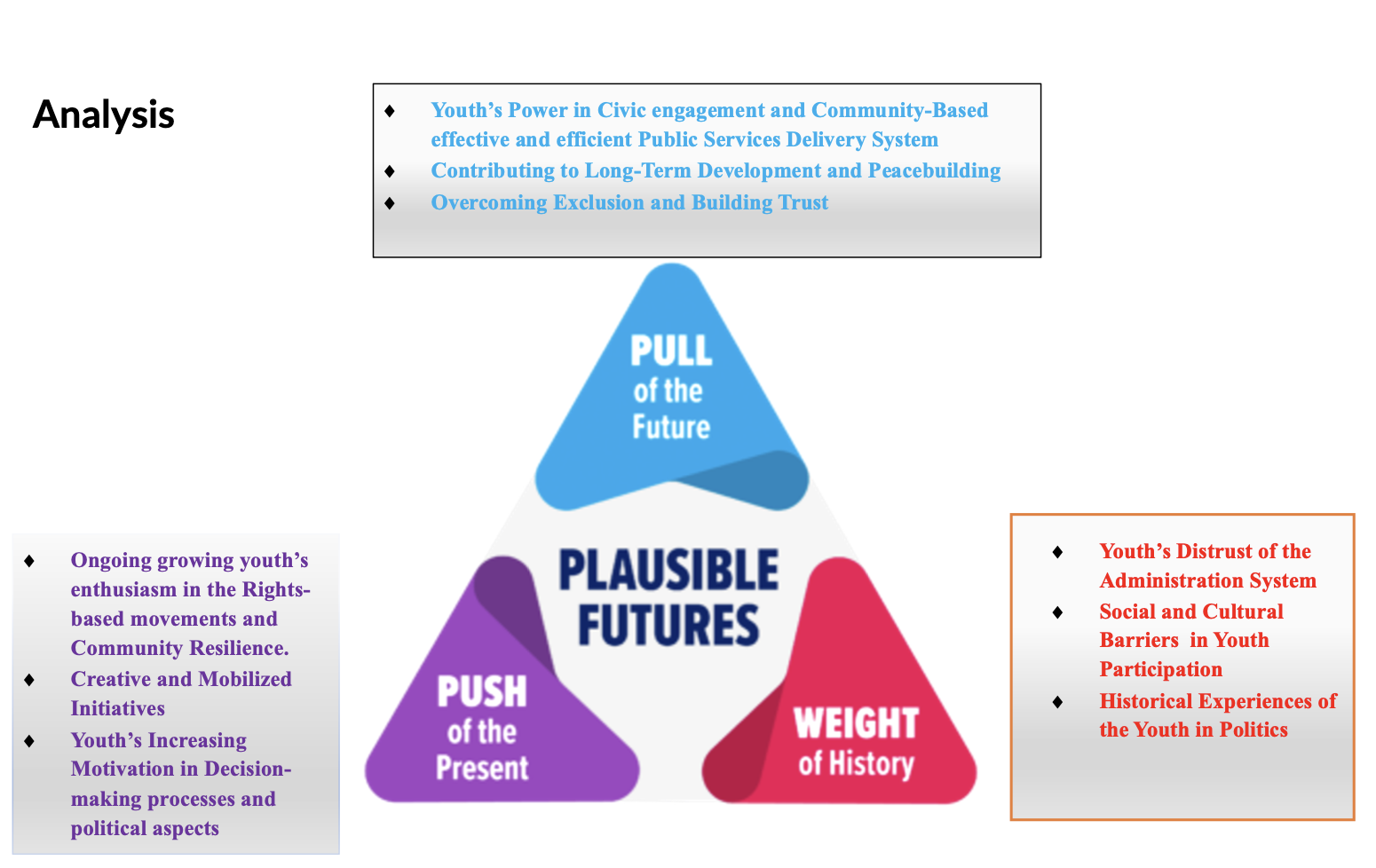
According to the futures triangle’s foresight view, the factors for the meaningful youth participation in Myanmar could be summarized as:
Weights of the Past
Youth’s Distrust of Administration system
The first National Youth Policy was developed in 2017 and was mainly led by under the Ministry of Social Welfare, Relief and Resettlement. The policy revolves around strengthening the Youth Affairs Committees (YACs) by being the representative body between youth networks, individuals, CSOs, and INGOs working with or for the youth nationwide,and the government for the whole policy process.
However, the longstanding dominance of military dictatorship in the administration system has created mistrust and hesitancy among youths to collaborate with YACs and ministerial departments. And the military representation in the parliaments as 25% mandatory with the constitution, which affirms the perception of manipulative patterns of military dictatorship.
Moreover, the divide-and-rule tactics of the military exacerbate the divisions between ethnic groups and the majority Burmese influenced YACs to engage effectively with diverse youth groups across various regions. This enhances the distrust and disbelief to the formal system and is being brought into the current youth participation in the policy processes.
Youths are still hesitant to take part in formal mechanisms, although current administration system is not being under the Military Junta. This is a significant setback that the current mechanisms are confronting at the local level, though providing the spaces to participate at the decision-making levels is not working for the young people on the ground.
Social and Cultural Barriers in Youth Participation
The common challenge for youth as norms is to take them account in decision-making levels are ageism and inexperience. Oftentimes, youth have been excluded from leadership roles by having defined the age of validity for the designated positions. Even in the democratic transition period, age defining for the leadership roles of the governance and public administration mechanism has been found.
Moreover, the diverse ethnicity, cultures, and beliefs of the country often bring the patriarchal version with strong deference to elders. This either reinforces favorable age hierarchical structures to elders especially in the dominant institutions as armed groups and religious organizations in many ethnic communities. (Briefing, 16 February 2023)This all contributed to the societal views on the decision-making positions and levels are not meant to be for young people and end up reluctant to create the opportunities for the youth in these positions. Moreover, youth convinced themselves that leadership roles and decision-making positions are not for them and always lack the confidence to take the opportunities.
Because of the intertwined geography, language and exposure to development limitations, youth from the ethnic groups are already in need of targeted supports in their capacity building and career opportunities. And the military junta’s manipulation of the majority Burmese influency and favoritism also leads to young ethnic people are far more left behind in grasping the education and economic opportunities. (Smith, february 2018). The majority of ethnic youth mentioned that they are not being used to take leadership positions especially in the formal policy processes with compounding challenges.
Historical Experiences of the Youth in Politics
Myanmar have always faced dynamic political situations, especially because of the authoritarian rule. Hence, the whole society has been experiencing multiple coups, resistance movements, and civil wars, along with all kinds of oppression, economic crisis, and poverty. However, Myanmar people have not given up their rights and voices along the way. They always showed up their strong resistance to oppression in different forms although most of the movements led to unpleasant endings with the complexity of political agendas and manipulations. In every historically significant events, young people has played a critical role as the leading positions. It is evidenced in 1988 student uprising, 2017 saffron revolution, and the democracy movements by arts, demonstrations, strikes and activism. Therefore, they have been targeted by the authoritarians through both systemic and brutal oppressions. Through the education system and propaganda, they have been equipped in positions where the threats are not questionable instead of showing their strong youth power.
Hence, the way youth experienced brutal breakdowns of the uprisings as in 1988 have always been haunting them and being reluctant to participate in any political movements and dealing with powerful people. Most of them always choose the safe way of not being involved in political things. Because of the attached nature of political system and governance system, they rarely interested in involving in decision-making roles as well. Although there are strong youth initiatives that demand for justice and rights during the oppressions, most of the young leaders often end up not being in power positions after the movements enter the system.
Push of the Present
Ongoing growing youth’s enthusiasm in the Rights-based movements and Community Resilience.
Following the 2021February coup, Myanmar Military has carried out various mass killings, arbitrary arrests, torture, sexual violence, and other abuses which lead to crimes against humanity, and restrictions on freedom of expression (Watch, 2023). Unlike earlier coups throughout history, the various resistance groups appeared from the civil servants as civil disobedience movements (CDM), students, and youth forces collaborated with other ethnic forces for the first time in history. And even after Military brutal crackdown to the peaceful protests, the evolution of the People’s Defence Forces across areas are led by and constituted mainly with youth forces as an armed resistance.
There are also youth-led civilian forces in the community which are involved in delivering urgent basic services like education, health, and humanitarian support and defending the rights of local community. These ground efforts are very crucial in current Myanmar political context among the widespread and systematic attacks against the civilian population nationwide among bombing schools, hospitals, and religious buildings with total impunity (Myanmar, 2025). These youth forces are always found to be connected at the center to other entities that support the anti-coup movements and community works. This portrays the high potential of youth-led movements and youth forces in present and future of Myanmar’s community resilience context and rights-based movements.
Creative and Mobilized Initiatives
The most distinct feature of this Spring revolution is its ability to utilize the creative and innovative ways throughout the diverse movements. These are almost entirely produced by the young people involved in different forms ofrevolution. It is seen in terms of digital technologies and social media by exploiting the opportunities as fundraising for the movements and also for the IDPs(Internally Displaced People), public services and emergency response, dissemination of information through various platforms to wider audience and get support from international and regional networks, and delivery of public services through online capacity building and direct services. Therefore, most of the respondents from diverse regions stated that there are lots of localized and synchronized online and offline community services led by youth as in community schools, local clinics, and early warnings and response.
Young people amidst targeted repression such as intentional arrests and interrogation without reliable reasons and with the forceful law as the conscription law (Ng, 2024), they are still sticking together with their community by using their unique creativity and mobilization skills in order to build the resilience and the country that the peaceful, diversity and justice are stored. Therefore, these initiatives have contributed as essential impacts in building community resilience and upcoming nation and state building processes.
Youth’s Increasing Motivation in Decision-making processes and political aspects
Following 2021 Military coup, the long-existing ethnic resistance organizations(EROs) and emerging people’s defense forces(PDFs) are fighting solely or making alliances to overthrow the nation’s military junta and state administration council(SAC) from their respective areas. As a result, liberated areas have been evolved and there is a need to govern these areas and provide the necessary public services. Therefore, the emerging local governments are formed mostly leading by respective armed groups and local leaders by bottom-up approach. (Martin, 2024). Since the roles of the young people in the local community is already been significant in the given context and also with the leadership and involvement of youth in the armed groups, young people’s participation in the decision-making processes has been seen a higher percentage in the local level. It is because of the recognition of the youth forces through their progressive movements against the coup by the decision makers and leaders of the existing governance mechanism. But it still seems lower in the village level, although degree has been increased accordingly at village tract and the township levels. Emphasizing this involvement and considering the importance will enhance the youth participation at the local decision-making levels and also to the policy processes across the areas.
Pull of the Future
Youth’s Power in Civic engagement and Community-Based effective and efficient Public Services Delivery System
After trapping under many decades-long conflict, Myanmar reached the critical points of restoring and strengthening for the nation and state building during or after the crisis. When it comes to resilience to the community in fragile settings, it is inevitable to admit that fulfilling the basic public services accessibility is an essential foundation. In thegiven political context, the basic services such as education, health, and emergency support are in urgent condition to be equipped almost everywhere. Although there are local emerging governance mechanisms, the nature of conflict enables these mechanisms will only be effective in the areas in which they are decentralized and encourage the local-led services delivery system (Martin, 2024). This is the space where the youth in the community could step in by utilizing their unique skills and knowledge of civic mobilization and leading in the implementation.
Evidencing current involvement of youth forces in these aspects also pointing out that young people will be the driving force for building country’s resilience through bridging the gaps in community needs across diverse geographical and political trends.
Contributing to Long-Term Development and Peacebuilding
The decades-long civil war and existing intense conflicts indicate that the suffer of the country has already exceeded its limit and needs an urgent intervention to restore peace and stability. While defending the brutal violence of the military junta, the peacebuilding should be considered on the one hand. Peacebuilding refers to the initiatives that seek to mitigate inter-ethnic, inter-faith and inter-communal tensions, and promote social cohesion. (Facility, 2017). For a country like Myanmar with its intertwined historical ethnic and religious tensions with its structural demotion by the authoritarians, it is critical to build strong social cohesion. This is the point where the roles of young people play significantly as peacebuilders. Youth in Myanmar already experienced and showed their commitment in the peace process as active citizens for peace, to reduce violence and to increase peaceful cohabitation. (Facility, 2017). Only with the restoration of peace especially at the community will enable the sustainable and development of the country. Hence, the future portrays the positive potential of utilizing youth forces in the peacebuilding and long-term actual development of Myanmar.
Overcoming Exclusion and Building Trust
It is always agree with the progressive agendas like the movements, activisms and initiatives demanding justice, equality, equity and human rights are always attached with the young people. Youth have been the drivers of societal change through utlizing social mobilization while pushing for themes in climate action, gender equality (NATIONS, APRIL 2023) recently. They showed their global leadership efforts by demanding decision-making and policy spaces through inclusive agendas that enable them providing diverse perspectives to improve and inform critical decisions.Nationally, Myanmar youth also provided the evidences of their power in the progressive agendas in the historical and ongoing democratic movements as in all forms of activism, demands and revolution.Even in this moment, young people also working on the gender equality issues as the longyi strike during protests, pushing for the social cohesion support among diverse ethnic and religions as in rohingya crises, and promoting the ideas of federalism and democracy. They prove that young people will be the torchbearers of the progressive ideas which could overcome the exclusion by building the trust of diverse regions, social and political context.
Conclusion and Recommendations
By addressing the key issues identified through three aspects of Futures Triangles method, the following policy recommendations have been able to be produced. This is done by the discussions of youth who are actively engaged in fulfilling the gaps of the current country’s ground realities and presuming the desired future that they want to possess in 2035:
- Creating and empowering an Inclusive Youth Platform across levels
Amidst diverse crises in each area, it is important to equip the common space for the youths under or across the governance mechanisms or regions to enable organizing the delivery of the needs and synergize the youth collective efforts.
- Designated Capacity,Skills and Support Programs for Youth
To ensure more inclusive youth leadership in decision-making and governance mechanisms, young people in Myanmar need to be supported the capacity and skills development programs specifically designed to them in topics like active citizenship, leadership to empower youth-led civic movements. Moreover, the mental health support and aid has been addressed as a critical need for the youth in Myanmar to build mental resilience which has been the key struggle during the intense growing conflicts.
- Guaranteed youth agendas and youth involvement in local decision-making and policy processes.
Rather than tokenistic agendas in the formalized processes, it is important to input youth agendas and consider youth involvement in the solid legislation evidences like in constitution and then guarantee youth participation in policy processes and arrangements like youth policy and youth departments especially at local governance and decision-making levels.
- Promoting Youth-induced funding
Budgeting is important for all the participatory youth inclusion works done in reality. And it is important to allocate a dedicated budget for youth programs by the relevant state actors and governance authorities. And the dedicated funding should be considered for the human resources skills development works funded by the non-state actors, non-government organizations and other related funding sources.
References
[1] Facility, P. S. (2017). Youth and Everyday Peace in Myanmar: Fostering the Untapped Potential of Myanmar’s Youth, PSF. Paung Sie Facility.
[2] Ministry of Women, Y. a. (September 2023). Youth in Myanmar’s Spring Revolution: their roles, strategies and political visions (Youth Vision). Ministry of Women,Youths and Children Affairs.
[3] Briefing, C. G. (16 February 2023). Breaking Gender and Age Barriers amid Myanmar’s Spring Revolution .International Crisis Group.
[4] Smith, M. H. (february 2018). Supporting youth contributions to peace in Myanmar. Dag Hammarskjöld Foundation .
[5] Watch, H. R. (2023). Myanmar Events of 2022. Retrieved from Human Rights Watch: https://www.hrw.org/world-report/2023/country-chapters/myanmar
[6] Myanmar, A. f. (2025, January 31). Myanmar: Four years after coup, world must demand accountability for atrocity crimes. Retrieved from amnesty international: https://www.amnesty.org/en/latest/news/2025/01/myanmar-four-years-after-coup-world-must-demand-accountability-for-atrocity-crimes/
[7] Ng, K. (2024, February 27). Myanmar: Young people attempt to flee ahead of conscription order. Retrieved from BBC News, Singapore: https://www.bbc.com/news/world-asia-68345291
[8] Martin, M. (2024, March 1). Myanmar’s Governance Challenges. Retrieved from Center for Strategic and International Studies: https://www.csis.org/analysis/myanmars-governance-challenges
[9] NATIONS, U. (APRIL 2023). Meaningful Youth Engagement in Policy-making and Decision-making Processes. United Nations (Policy Brief 3).
Download full article: Click